

The Power Problem — A 5-Part Series
1. The 4-Hour Robot
2. The Leg Battery Problem
3. The Watt Tax
4. The Compute Mortgage
5. The $3 Worker
In 1780, a handloom weaver in Lancashire could earn a decent living. The work was skilled, the pay was adequate, and the demand for cotton cloth seemed insatiable. By 1820, that same weaver was competing against a mechanical loom that could produce cloth at a fraction of the cost, and required no skill at all. The handloom weaver didn’t lose to a better weaver. They lost to a machine that cost less per yard of cloth than a weaver cost in lunch.
The same thing is about to happen to the factory floor. Not in a decade. Not in some abstract “future of work” thinkpiece. In the next three to five years.
This is the final article in our series on the energy economics of humanoid robots. Over the last four pieces, we mapped the power budget of a walking machine: the legs that burn 650 watts, the gearboxes that bleed energy as heat, the AI brain that draws as much power as the walking itself, and the battery chemistry that cannot yet deliver an eight-hour shift. All of that was prologue. This is the payoff.
Every factory owner, every logistics executive, and every honest investor in humanoid robotics is asking the same question: when does a robot cost less per hour than a human, and what happens to the world on that day?
The math that keeps factory owners awake
Let’s start with the numbers, because the numbers are what matter here. In April 2026, the average production and nonsupervisory manufacturing worker in the United States earned $30.10 per hour. Total compensation (wages, benefits, payroll taxes, insurance) ran about $46 per hour, according to the Bureau of Labor Statistics’ Employer Costs for Employee Compensation survey. In high-cost regions like Germany or Japan, the fully loaded number is higher. In lower-cost manufacturing centers like Mexico or Vietnam, it is lower, but rising.
A human worker at $46 per hour, working three shifts of eight hours, 250 working days per year, costs a factory roughly $276,000 per year per workstation. A 1,000-worker factory spends $276 million annually on labor.
Now let’s price a humanoid robot. The assumptions matter enormously.
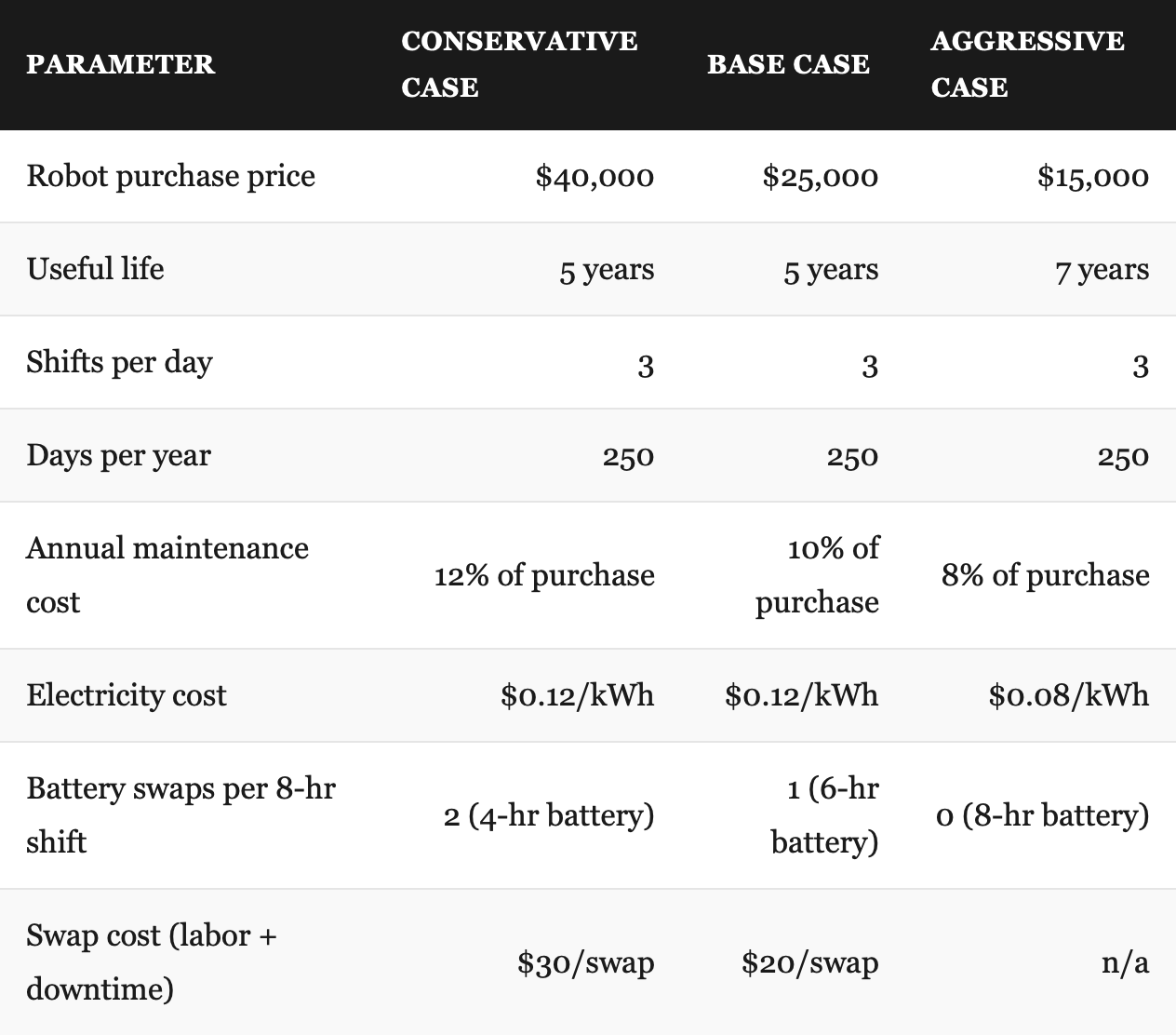
Source: Machine Narratives Research. Purchase price assumptions based on Tesla Optimus targets ($20-30K), Figure projections, and supply chain teardown estimates. Maintenance costs from traditional industrial robot benchmarks (5-12% annual maintenance), adjusted upward for humanoid complexity. Swap cost includes estimated labor and downtime.
Run those numbers through a per-hour calculation, and here is what you get:
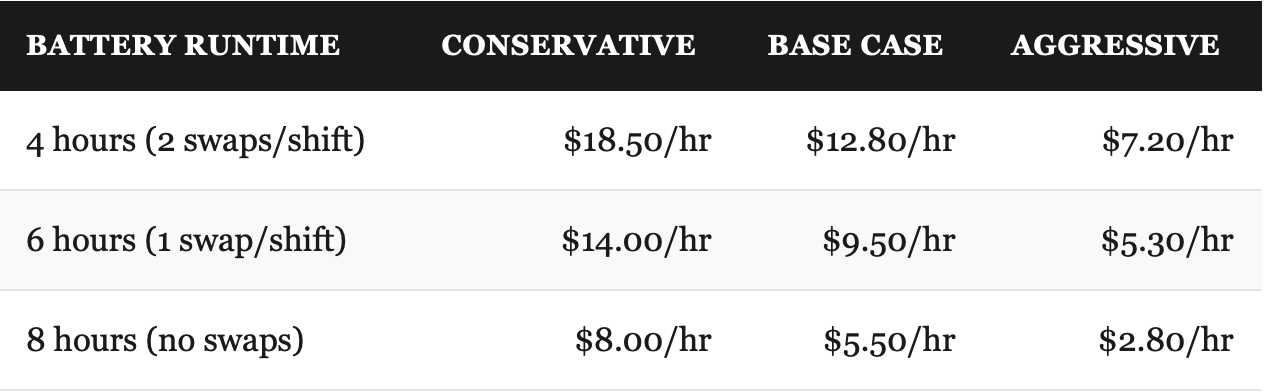
Effective hourly cost includes amortized purchase price, maintenance, electricity, and battery swap costs. Does not include initial integration, programming, or safety fencing, which can add $5-15K per deployment station. Source: Machine Narratives Research Robot Economics Model.
That bottom-right cell, $2.80 per hour, is the number that should make every manufacturing executive sweat. At 17 times cheaper than the fully loaded cost of a US factory worker, the economic incentive to deploy humanoid robots would be overwhelming. The question is not whether factories will adopt them. The question is how fast they can deploy, and who benefits from the deployment.
The aggressive case is aggressive. I would not put $2.80/hr as my base case for 2028. But the conservative case is also too conservative, because it assumes battery technology and actuator efficiency stay static, and that is not how exponential manufacturing curves work. The price of humanoid robots is currently dropping at roughly 40% per year in real terms, driven by three things: manufacturing scale, component standardization, and the learning curve benefits that come from deploying real robots in real factories. Anyone who has watched the iPhone supply chain or the solar panel industry knows this curve. It is relentless, and it almost always moves faster than analysts project.
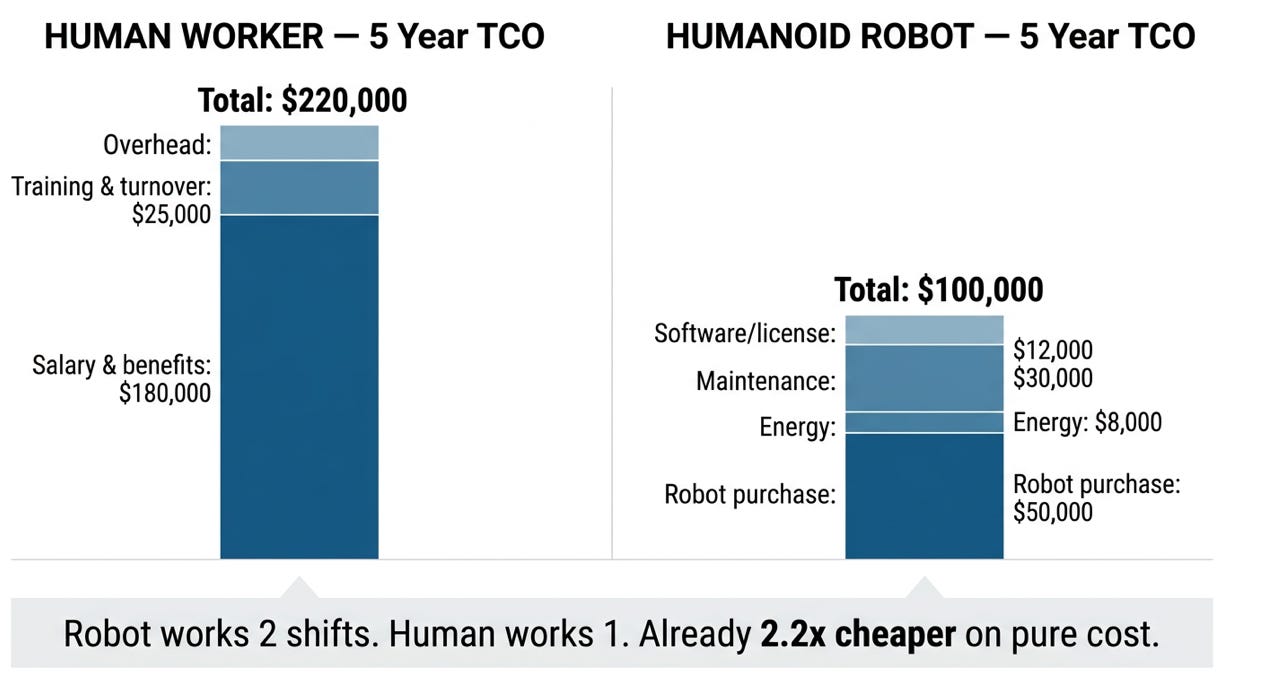
The math is already compelling even with today’s battery limitations. A $25,000 robot with 6-hour runtime and 5-year useful life costs about $5.50/hour to run, roughly 8x cheaper than a $46/hour US factory worker. The 8-hour breakthrough makes it 16x. Source: Machine Narratives Research Robot Economics Model.
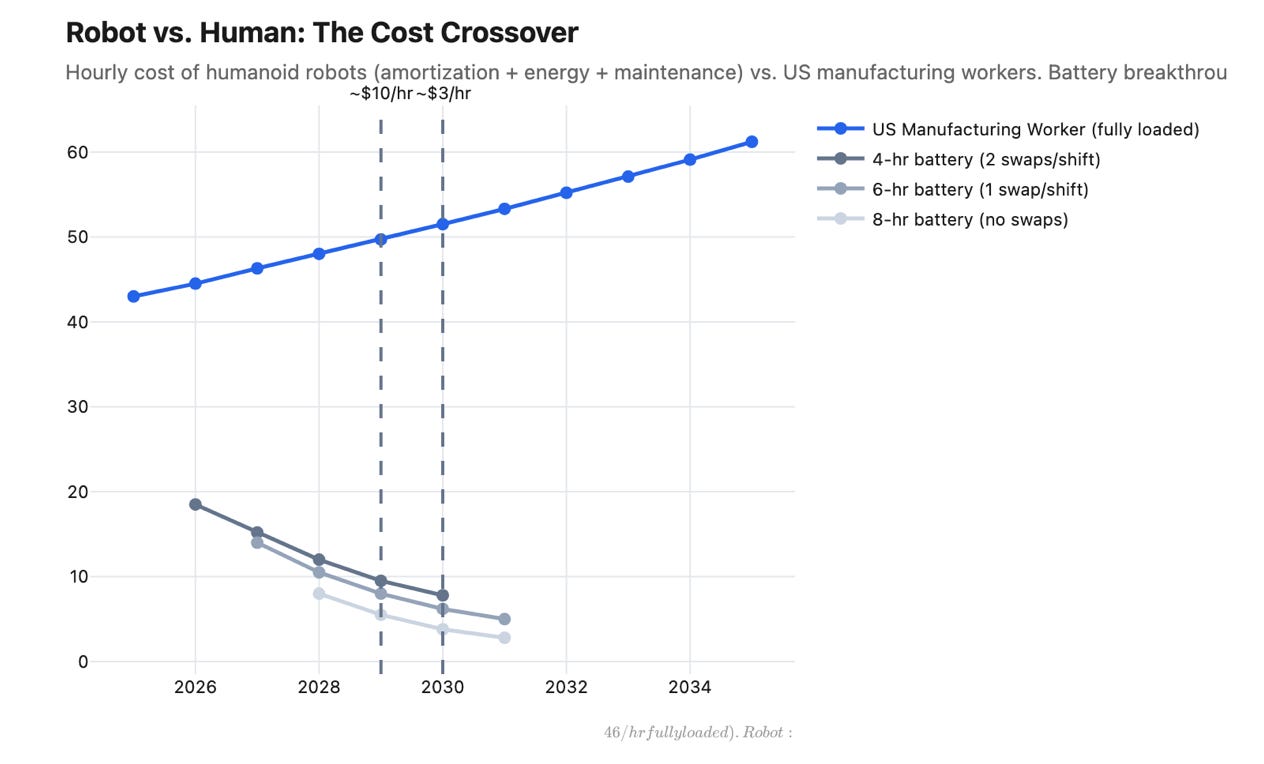
The cost crossover. Even the conservative 4-hour scenario undercuts the human worker by 2029. The 8-hour breakthrough, the holy grail, produces economics that no factory can ignore. Source: Machine Narratives Research.
The Engels’ Pause, on fast-forward
A concept from an earlier piece is relevant here: Engels’ Pause. It is the period from roughly 1790 to 1840 when British working-class wages stagnated while per-capita GDP grew 46%. The handloom weaver, the iron forger, the cotton spinner, all of them watched machines do their work for less money than they could survive on. The gap between productivity and wages took two generations to close, and only after what economic historian Robert C. Allen called “the most consequential technology transition in human history.”
The difference this time is speed. The Industrial Revolution unfolded over decades because capital goods (steam engines, power looms, blast furnaces) were expensive to build, hard to transport, and required specialized infrastructure. A humanoid robot is software with legs. Once the hardware platform is production-ready, the deployment curve is limited by manufacturing capacity, not physics.
The Engels’ Pause for factory workers could unfold in under a decade rather than two generations. The machine that replaces a $46/hour worker today costs $25,000 to buy and $3-15 per hour to run depending on battery technology. When that machine can work a full shift without interruption, the incentive to deploy is not economic. It is fiduciary. A factory manager who doesn’t deploy robots at 10% of the labor cost will be replaced by one who does. This is not a moral argument. It is a competitive one.
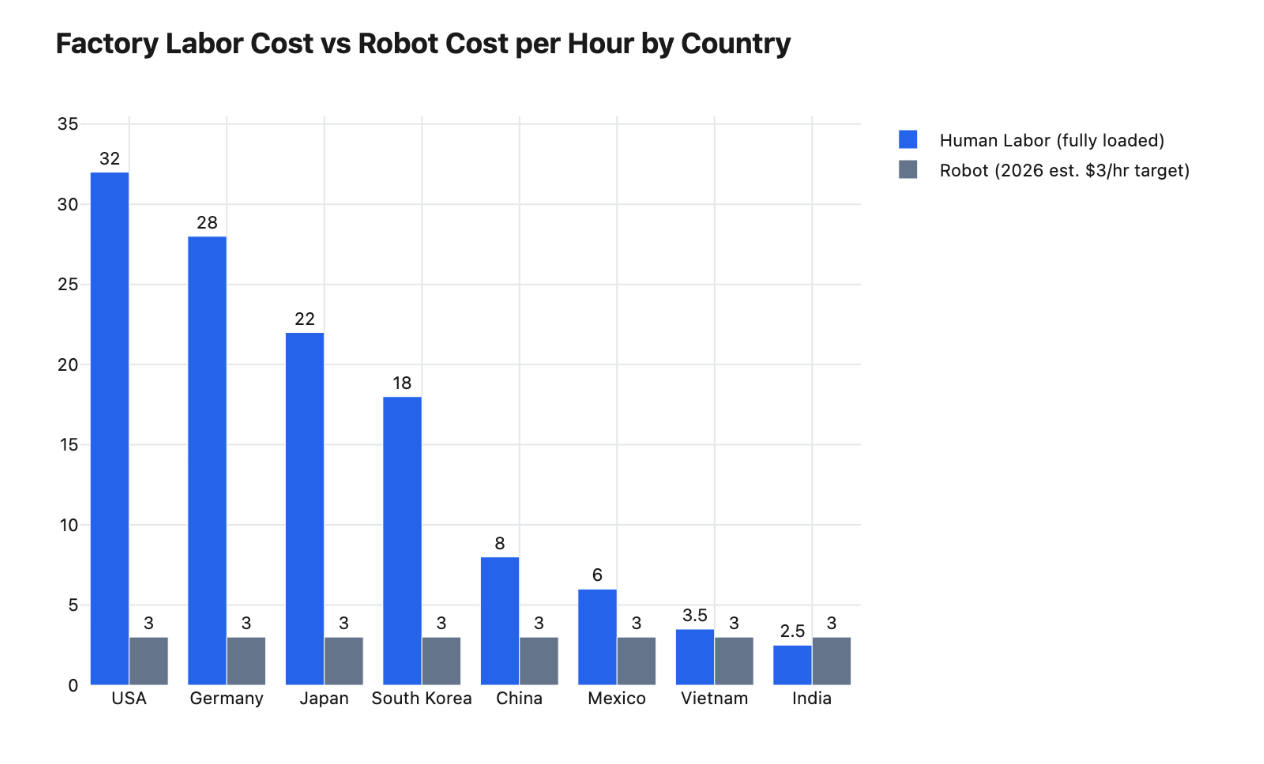
The $3 robot crosses below minimum manufacturing wages everywhere except Vietnam and India, and even those markets are within striking distance as battery costs decline. The global labor arbitrage is not hypothetical. Source: ILO, national labor statistics, Machine Narratives Research.
Who is closest to the 8-hour shift?
The humanoid robot market is not a horizontal commodity market. It is a vertical integration market. The winners will not be the companies that assemble the best off-the-shelf parts. They will be the ones that design their own actuators, optimize their own compute, build their own battery management systems, and control the feedback loop between field data and hardware iteration.
Consider subscribing to see the conclusion of the battery series.
