

Eyes of the Machine: A 3-Part Series
1. Cameras, LiDAR, Depth Sensors: The $38B Format War
2. Software Eats the Sensors
3. Sony Won the Last Camera War. Who Wins This One?

Ouster’s software-attached bookings doubled in 2025. Software now ships with more than 15% of their sensors. When a customer buys an Ouster LiDAR unit, they’re increasingly also buying the software that processes the data. The sensor is becoming a distribution channel for perception software.
That pattern should look familiar. In every hardware market that scaled, the value migrated from the physical tool to the intelligence running on top of it. The same thing is happening in robotics perception. If you’re still thinking about the humanoid robot perception stack as a hardware problem, you’re looking at the wrong layer.
The core question: As sensor hardware commoditizes, where does the margin go? We think it goes to the fusion software layer. The companies building it today will tax every robot that ships when volumes arrive in 2028-2030.
If this analysis is useful, subscribe for free to follow the full Eyes of the Machine series.
What Sensor Fusion Actually Does
A humanoid robot carries between four and eight cameras, one or two LiDAR units, multiple depth sensors, and six or more inertial measurement units. Each sensor produces data in its own coordinate system, at its own clock rate, with its own noise profile. A camera delivers 30 frames per second of 2D pixel data. A LiDAR unit delivers 300,000 3D points per second. An IMU delivers acceleration and angular velocity at 1,000 Hz. None of them agree on where “here” is.
The robot needs one coherent model of the world, updated in real-time, accurate enough to grab a cup off a table without crushing it. Sensor fusion is the software that makes that happen. The pipeline has four stages.
Calibration aligns every sensor to a common coordinate frame. Get this wrong by two degrees and the robot’s hand lands three centimeters from where its eyes said the cup was.
Synchronization time-aligns data from sensors running at different rates. The IMU fires at 1,000 Hz. The camera fires at 30 Hz. The LiDAR spins at 20 Hz. The fusion algorithm interpolates, predicts, and merges these streams into a single timeline without introducing lag.
Filtering removes noise, handles occlusions, and manages conflicting data. When the camera says there’s an obstacle at 1.2 meters and the LiDAR says 1.4 meters, the software decides which sensor to trust based on noise models and confidence scores.
Registration combines 3D point clouds from different sensors into one unified model. Then SLAM (simultaneous localization and mapping) answers the two questions every mobile robot needs answered constantly: Where am I, and what’s around me?
Object recognition sits on top of the fused 3D model: “that’s a coffee mug, it’s full, and it’s on the edge of the table.”
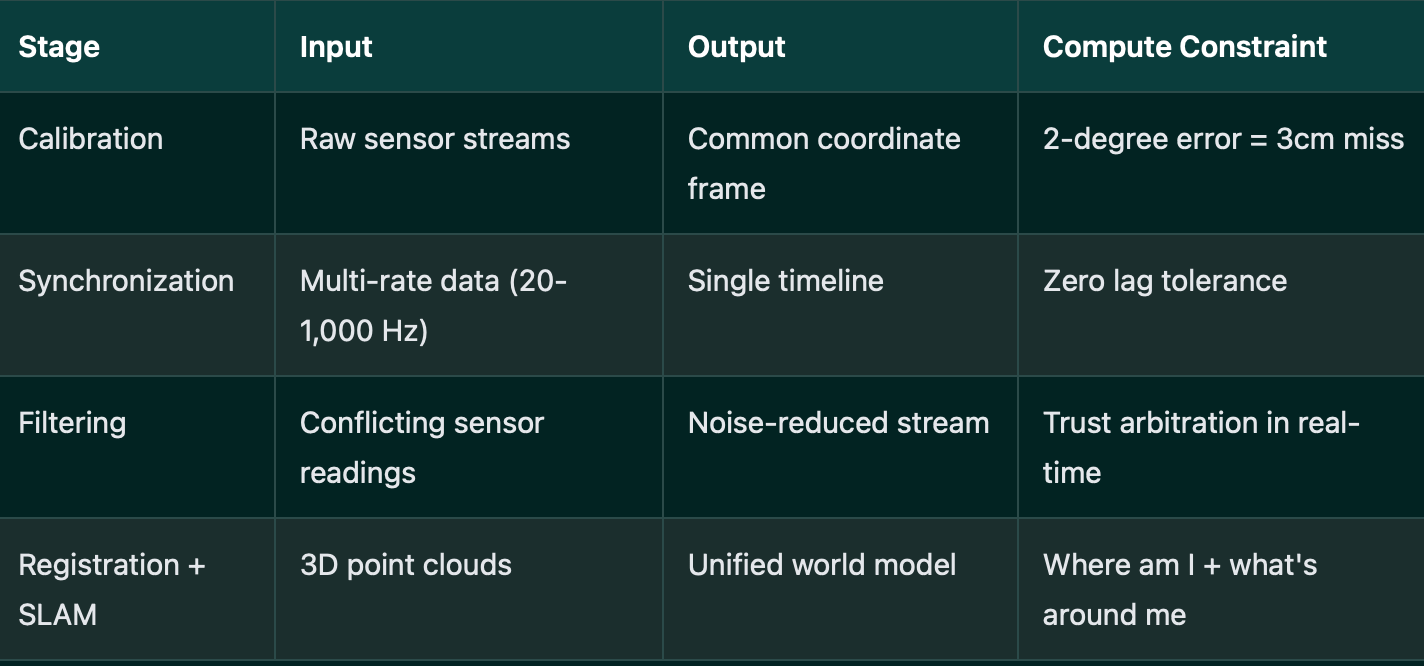
The compute budget runs $500 to $1,500 per robot in dedicated neural processing units. That’s not a cloud workload. Every watt matters. Every gram matters. The fusion software has to run on the robot, in real-time, with a power budget that wouldn’t charge your phone.
Hardware Down, Software Up
The sensor itself is becoming the cheapest part of the stack.
Hesai has deployed more than one million LiDAR units. That volume turns a specialized optical instrument into a manufactured commodity. The engineering moat that justified premium pricing five years ago is eroding as manufacturing scales and alternative architectures (solid-state, flash, MEMS) compete on cost.
Camera modules already operate at 15-25% gross margins. LiDAR hardware sits at 25-40%. We saw this pattern in CMOS image sensors: Sony, OmniVision, and Samsung now compete in a market where the sensor itself accounts for less than 10% of the total camera system value. The value migrated to image signal processors, computational photography algorithms, and the AI models that turn raw pixels into usable data.
LiDAR is following the same trajectory. The hardware is commoditizing. The software that processes the point cloud is concentrating. If you’re investing in the humanoid robot perception stack based on who makes the best LiDAR unit, you’re looking at the commodity layer.
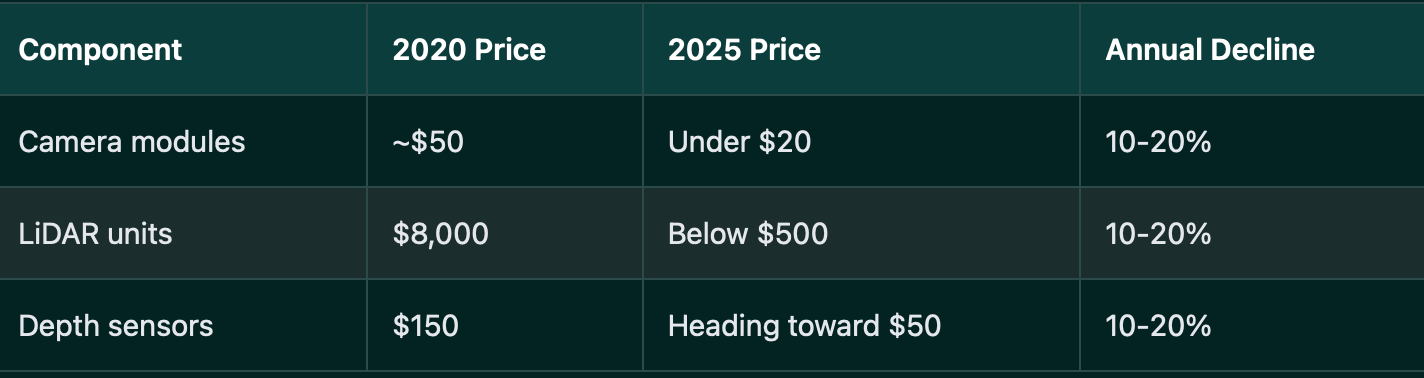
The specific cost trajectories and technology comparisons are covered in Part 1 of this series. The point here is directional: hardware margins will compress. The question is where the margin goes.
The Margin Stack
Gross margins tell the story in a single number.
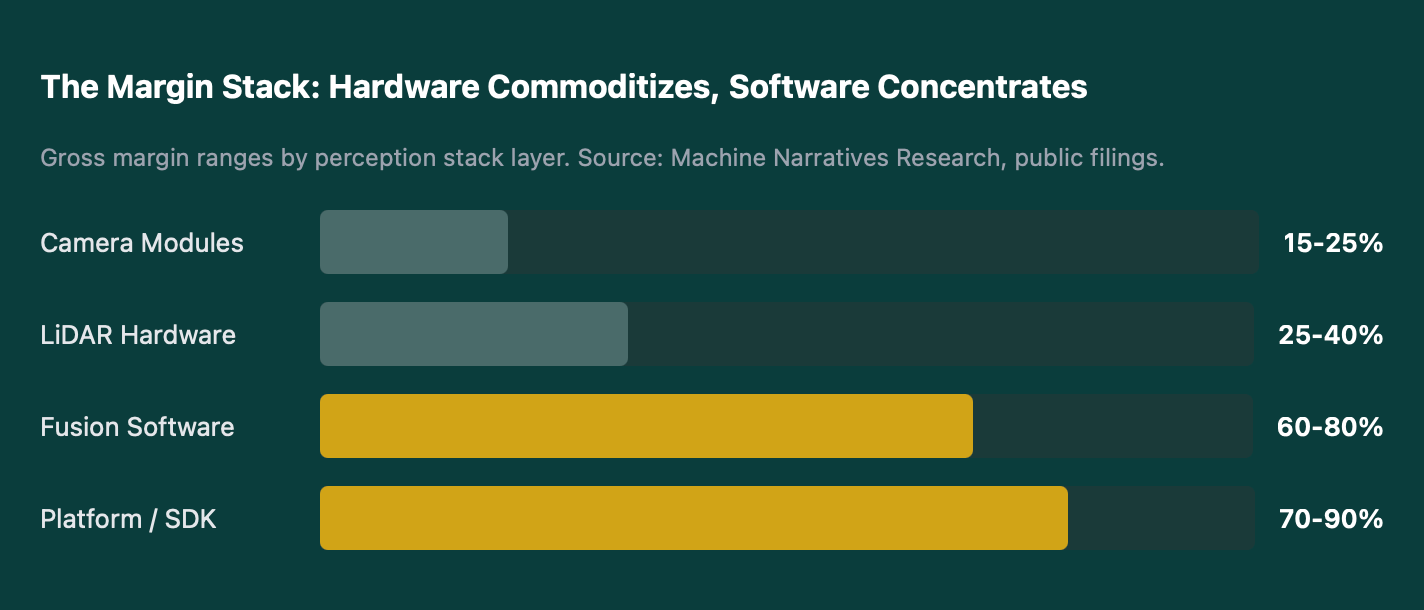
Fusion software runs at 60-80% gross margins because every additional robot running your stack costs almost nothing in marginal compute. The fixed cost of developing the algorithms amortizes across millions of units. Hardware doesn’t work that way. Every sensor costs roughly the same to build whether you ship one or one million.
Ouster is betting on this margin migration. Sell sensors at hardware margins. Sell the software that processes sensor data at SaaS margins. The sensor becomes the customer acquisition cost for the software business.
The companies that still think they’re in the sensor business are fighting over margins that will be gone by 2028. The companies that know they’re in the spatial intelligence business are building the moat that will define the stack.
Subscribe to see where the value actually migrates, which tickers capture the fusion software layer, and why NVIDIA’s platform play is both the answer and the risk.
Subscribe to finish the article. See where the value actually migrates and which tickers capture the fusion software layer.
