

The Sensor Nobody Covers: A 4-Part Series
1. The $168M Nobody Sees
2. 2,500 vs 12 - Why Robots Still Can’t Feel
3. Double Dependency - China’s Grip on Robots
4. The Real Alpha is One Layer Deeper
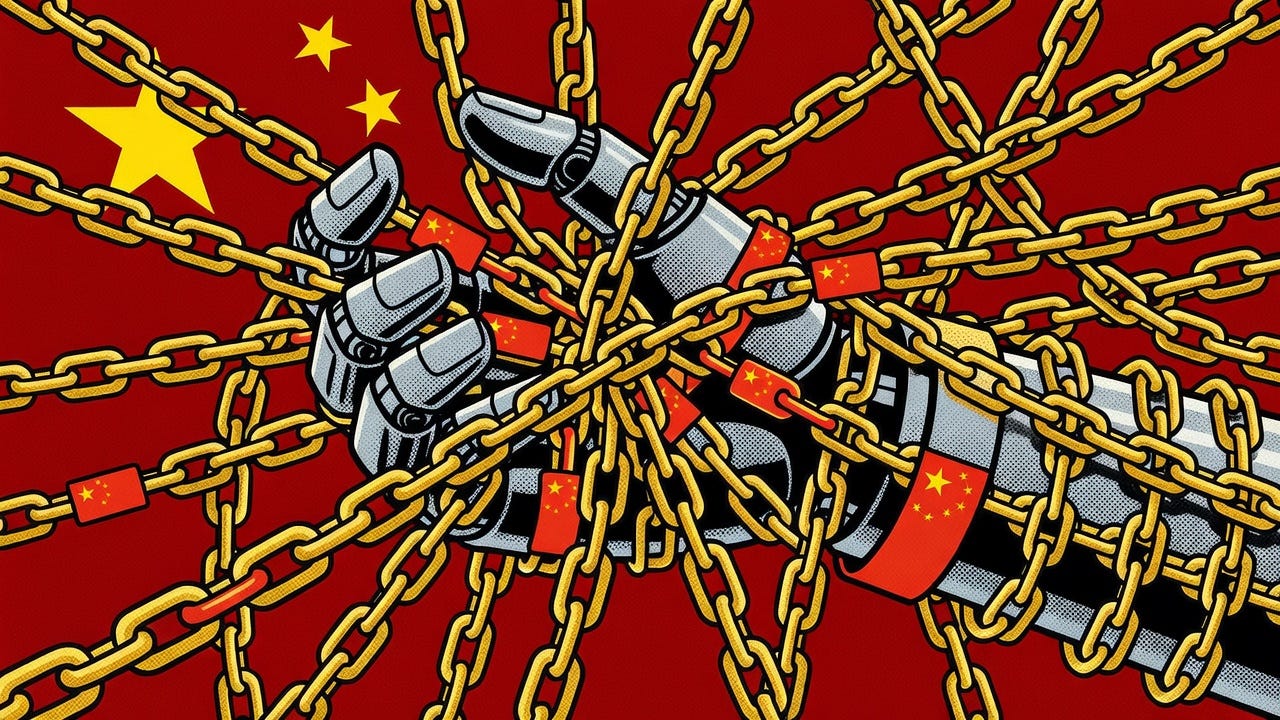
ATI’s Gamma series force/torque sensor costs $5,000 to $10,000. Chinese alternatives deliver comparable performance for $1,500 to $3,000. At 10,000 robots per year, that’s $100-200 million in annual sensor spend. No CFO ignores that number. The cost gap is real. The question is why it exists, and whether it’s permanent.
In Part 1 of this series, we showed the $168 million market nobody’s tracking. In Part 2, we showed the touch gap: 12 sensing points on a robot fingertip versus 2,500 on yours. This is the part where it gets uncomfortable.
The Flywheel
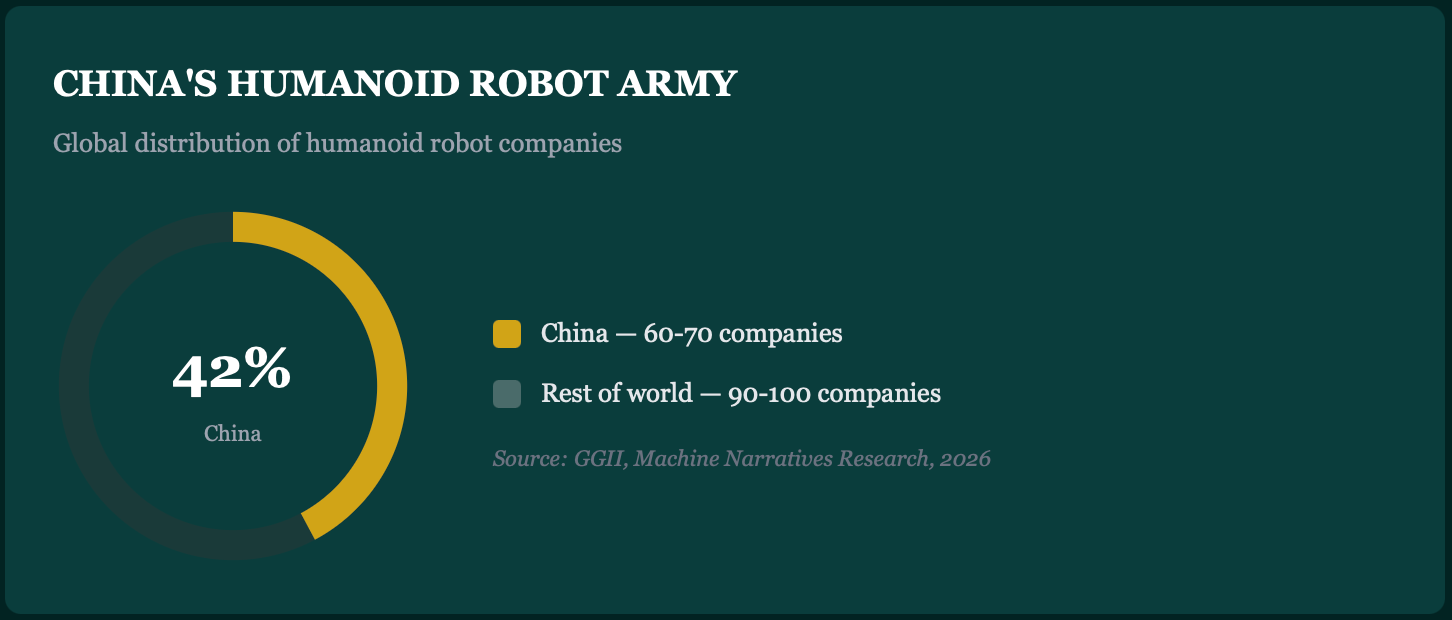
Chinese sensors are cheap for a reason, and the reason compounds. China has 60-70 humanoid robot companies, more than 40% of the global total. That domestic scale creates feedback loops Western suppliers can’t access. Chinese sensor companies iterate on OEM feedback in weeks. They customize in days. Every cycle drives the cost advantage deeper, which pulls in more domestic customers, which drives more scale. The flywheel spins faster every quarter.
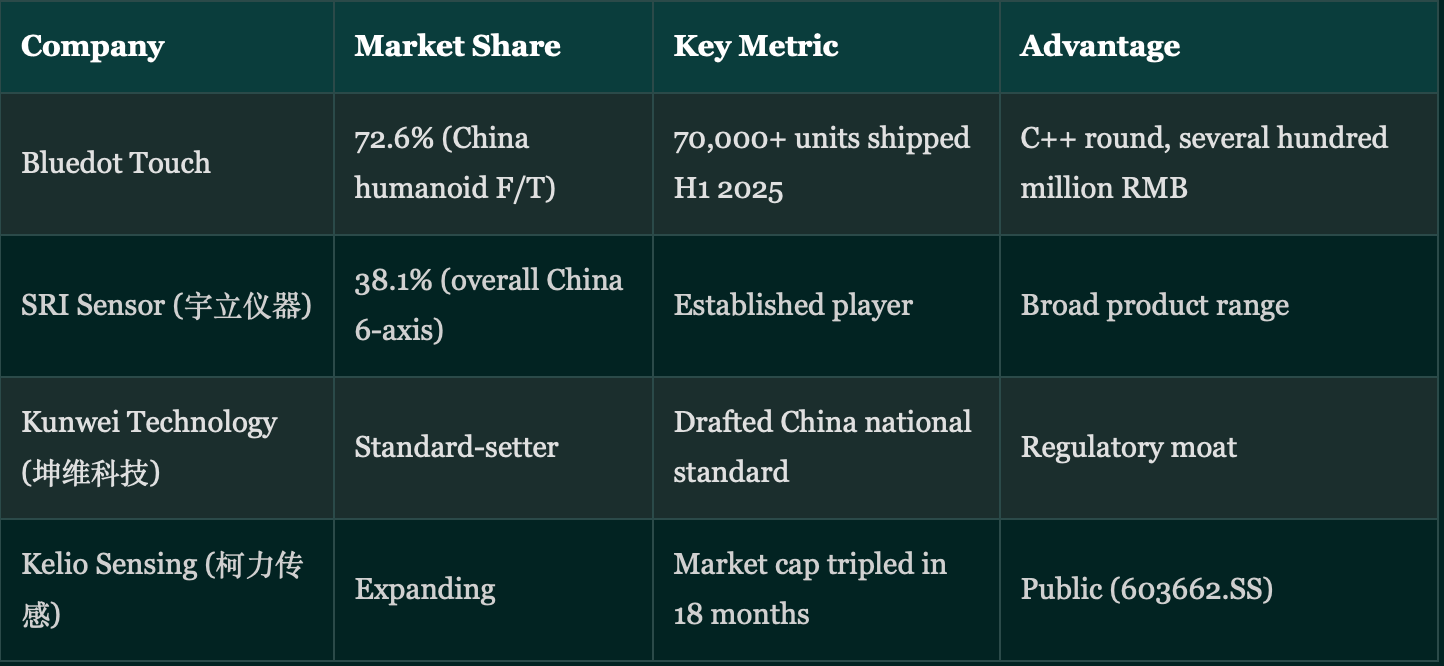
62% to 72.6% in one year.
Ten percentage points of consolidation. 70,000+ joint force sensor units shipped in H1 2025. 95% domestic market share in that category.
They're not alone. SRI Sensor (宇立仪器) holds 38.1% of the overall China 6-axis F/T sensor market. Kunwei Technology (坤维科技) drafted China's national standard for robot sensor testing. When your company writes the national testing standard, that's a regulatory moat. Kelio Sensing (柯力传感), publicly traded in Shanghai (603662.SS), has seen its market cap triple in 18 months.
China has 60-70 humanoid robot companies, more than 40% of the global total. GGII projects 12,300 six-axis F/T sensor shipments in 2025, with humanoid applications accounting for more than 30% of total demand. A year ago, humanoid was barely a line item. Now it's driving the market's growth trajectory. Chinese sensor companies get feedback loops from domestic OEMs that Western companies can't access. They iterate faster. They customize faster. They scale faster. That combination of production dominance and domestic demand creates a flywheel that's hard to compete with from the outside.
30-50% cost advantage. 28% of global demand.
China isn't just manufacturing sensors. It's consuming them.
A note on sourcing: the 72.6% and 38.1% figures trace to a single GGII report. We’ve cross-referenced against public filings and industry contacts where possible. Treat the directional trend as solid; the exact percentages as approximate. If anything, the real concentration may be higher. GGII’s methodology counts domestic sales, not design wins for future platforms where Bluedot is also winning.
The Double Chokepoint
The sensor flywheel is bad enough on its own. It’s worse when you remember the magnets.
In our Materials series, we showed how China controls 94% of NdFeB magnet production globally. When export controls tightened, prices surged 200-300%. Lead times stretched to 12 months. Some OEMs redesigned entire actuator assemblies to reduce magnet dependency. Companies that had sourced exclusively from Chinese suppliers found themselves with no fallback.
We showed you that. What we didn’t show you until now is that the same playbook is running in sensors. Different material. Same leverage. Same country.
94% of magnets. 72.6% of sensors.
Two chokepoints, one country. When China restricted rare earth exports in 2010, prices spiked 300% overnight.
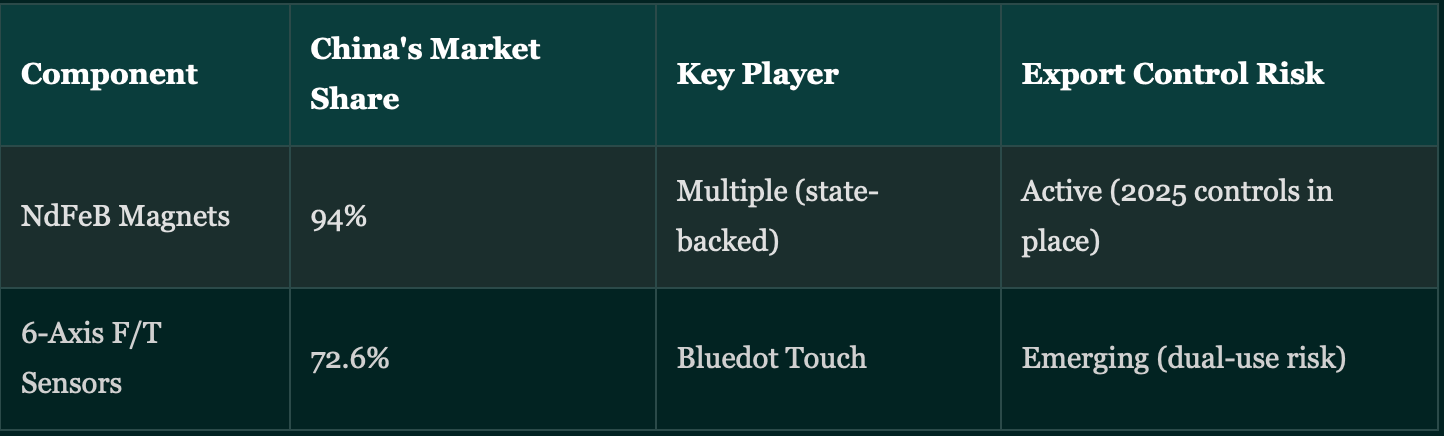
Source: GGII, Machine Narratives analysis
Every humanoid robot requires neodymium magnets in its actuators and force/torque sensors in its joints. China dominates both supply chains. The NdFeB chokepoint took a decade to form: a slow consolidation driven by state subsidies, environmental deregulation, and strategic acquisitions that Western competitors watched happen in real time and did nothing about. The sensor chokepoint is forming in two to three years. Same playbook. Faster execution.
Now you see why two chokepoints is fundamentally different from one. The first is a cost problem. The second is an existence problem.
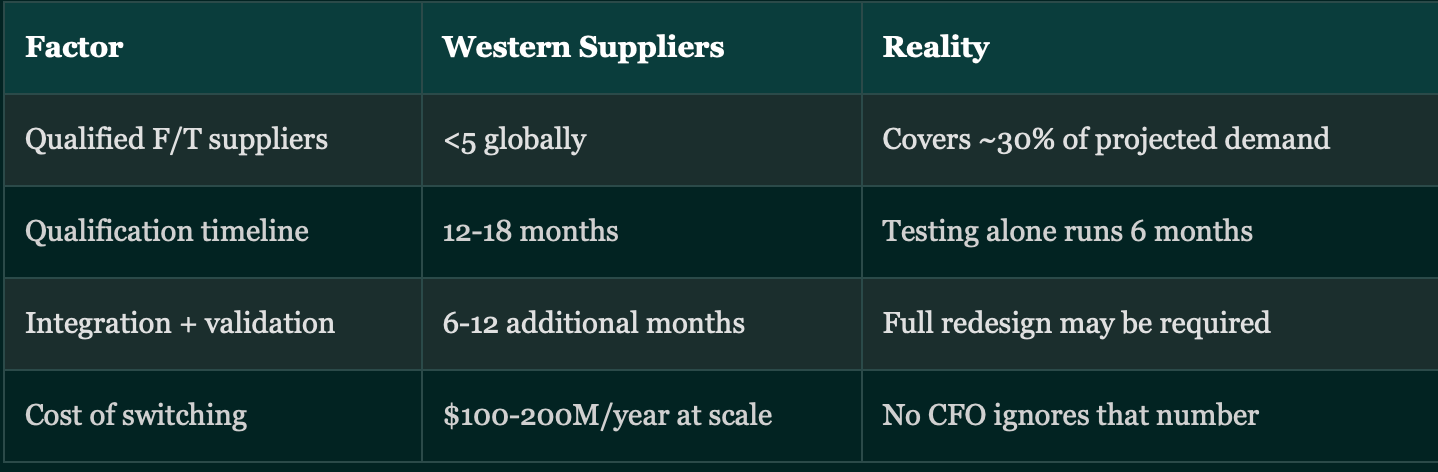
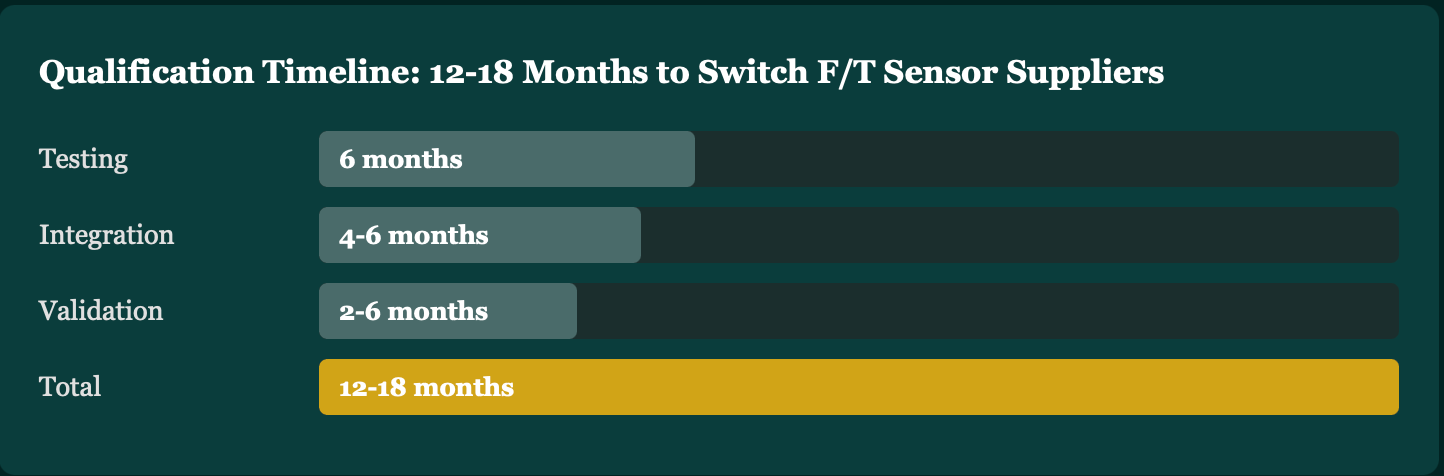
Consider the scenario. A mid-tier Western OEM targeting commercial deployment in 2027 needs 12-16 force/torque sensors per unit and 20-30 neodymium magnets per actuator assembly. If China restricts magnet exports, the robot costs 20-30% more to build. It still ships. Now add sensor restrictions. There are fewer than five qualified Western F/T sensor suppliers globally. Their combined capacity covers maybe 30% of projected demand. Qualifying a new sensor takes 12-18 months. The robot doesn’t ship.
Source: Machine Narratives analysis
Nobody is aggregating this risk. The sell-side covers magnets in one report and sensors in another. We've read the robotics coverage from every major bank. Not one models the compounding dependency. They treat magnets and sensors as independent variables. They're not. They're correlated exposures to the same country risk. If China restricts both, there is no humanoid robot industry outside China.
