The Sensor Nobody Covers: A 4-Part Series
1. The $168M Nobody Sees
2. 2,500 vs 12 - Why Robots Still Can’t Feel
3. Double Dependency - China’s Grip on Robots
4. The Real Alpha is One Layer Deeper
In the early 1990s, the obvious semiconductor bets were Intel, AMD, Motorola. The chip designers everyone knew. But the real wealth was in the component layer. ASML made the lithography machines. Applied Materials made the deposition tools. Lam Research made the etchers. Boring, obscure companies that sold to chipmakers, not consumers. ASML went from $20 to $1,000. Applied Materials from $5 to $200. The chip designers had brutal drawdowns. The tool makers just kept compounding, because every chip company needed their tools.
I keep thinking about that pattern when I look at the sensor market.
The Layer Cake
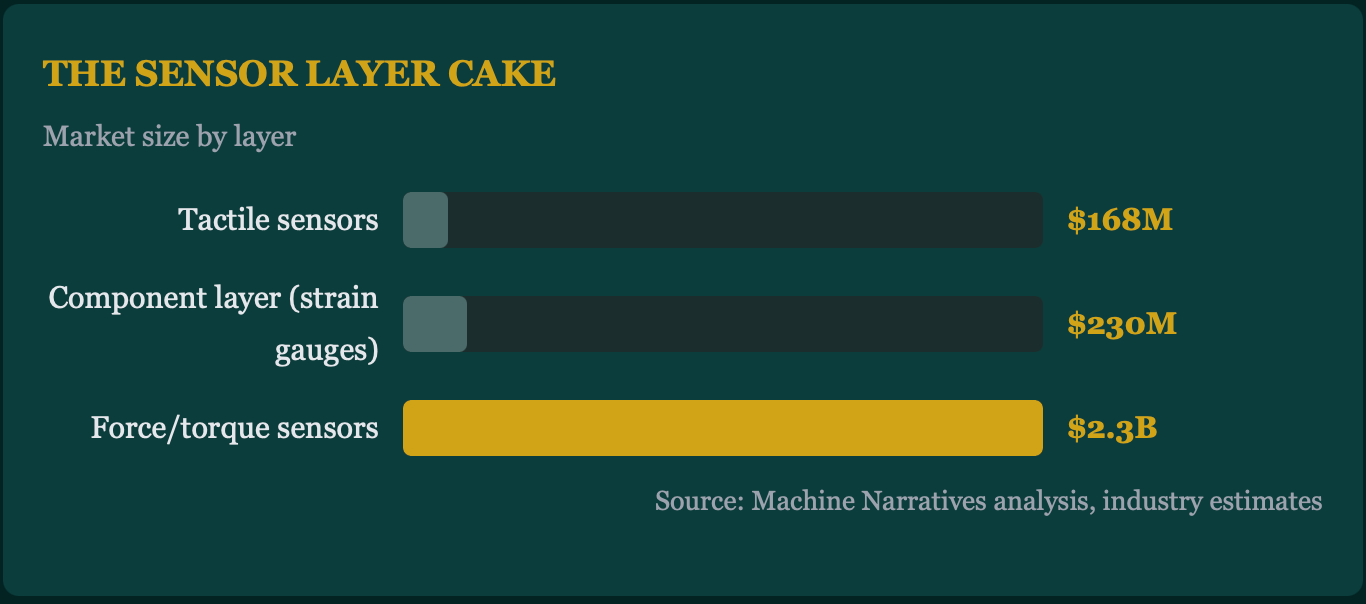
The sensor supply chain looks like a layer cake. Sensor market at the top: $168 million for tactile, $2.3 billion for force/torque. The next layer is the sensor integrators: ATI, XELA, Bluedot Touch. They buy components, assemble sensors, sell to robot OEMs. Below that, the component suppliers: strain gauges, signal conditioning chips, connector assemblies. At the bottom, raw materials: metal alloys, semiconductor substrates, specialty adhesives.
Each layer is more concentrated than the one above it. Each layer is less covered by analysts. And each layer has more pricing power than the one it sells to.
The sensor integrators get all the attention. The component suppliers get almost none. That’s where the alpha is.
Inside every force/torque sensor bolted into robot wrists, ankles, and joints, there’s a sensing element. A thin foil or semiconductor pattern bonded to a metal beam. When the beam flexes, the foil deforms. Its electrical resistance changes. That change gets measured, amplified, and converted into a number telling the robot how much force it’s applying.
That sensing element is a strain gauge. The companies that make them are more concentrated, less covered, and more critical than the sensor companies themselves.
Seventy Years, No Substitute
A strain gauge is a thin metallic foil, usually constantan alloy, patterned into a grid and bonded to a structural element. When that element bends under load, the foil stretches. Its electrical resistance changes proportionally. A Wheatstone bridge circuit measures the change, typically in microvolts. Signal conditioning electronics amplify and digitize it. The result is a precise force or torque reading.
The concept dates to 1856, when Lord Kelvin discovered that the electrical resistance of wires changed under stretch. The modern bonded foil strain gauge was independently developed in the late 1930s by Edward Simmons and Arthur Ruge during aircraft structural testing. The technology was classified for military use during World War II. After the war, it entered commercial manufacturing and became the foundation of the entire load cell and force measurement industry.
That was seventy years ago. Nothing has displaced it.
Every six-axis force/torque sensor uses strain gauges. Piezoelectric sensors exist for dynamic measurements, but they can’t hold a static reading. Capacitive sensors work for some applications but lack the precision and temperature stability for robotics-grade force measurement. Strain gauges are the only technology that does what robots need, at the precision robots require, at a cost that scales.
They’re inside every load cell, every force sensor, every structural test rig in aerospace, automotive, and manufacturing. The Boeing 787’s wing flex testing used strain gauges. Every crash test dummy has them. And they’re about to be inside every humanoid robot that ships.
$230 million. The entire component layer inside a multi-billion-dollar measurement industry. Growing at 3-4% annually. Boring, steady, invisible. Until humanoid robots start shipping at volume.
The global strain gauge market is roughly $230 million in 2026. The entire component layer inside a multi-billion-dollar measurement industry is smaller than a single mid-cap tech company’s quarterly revenue. Growing at 3-4% annually. Boring, steady, invisible. Until humanoid robots start shipping at volume.
If this analysis is useful, subscribe to see the four companies who make strain gauges and where the Alpha lives in sensors.