


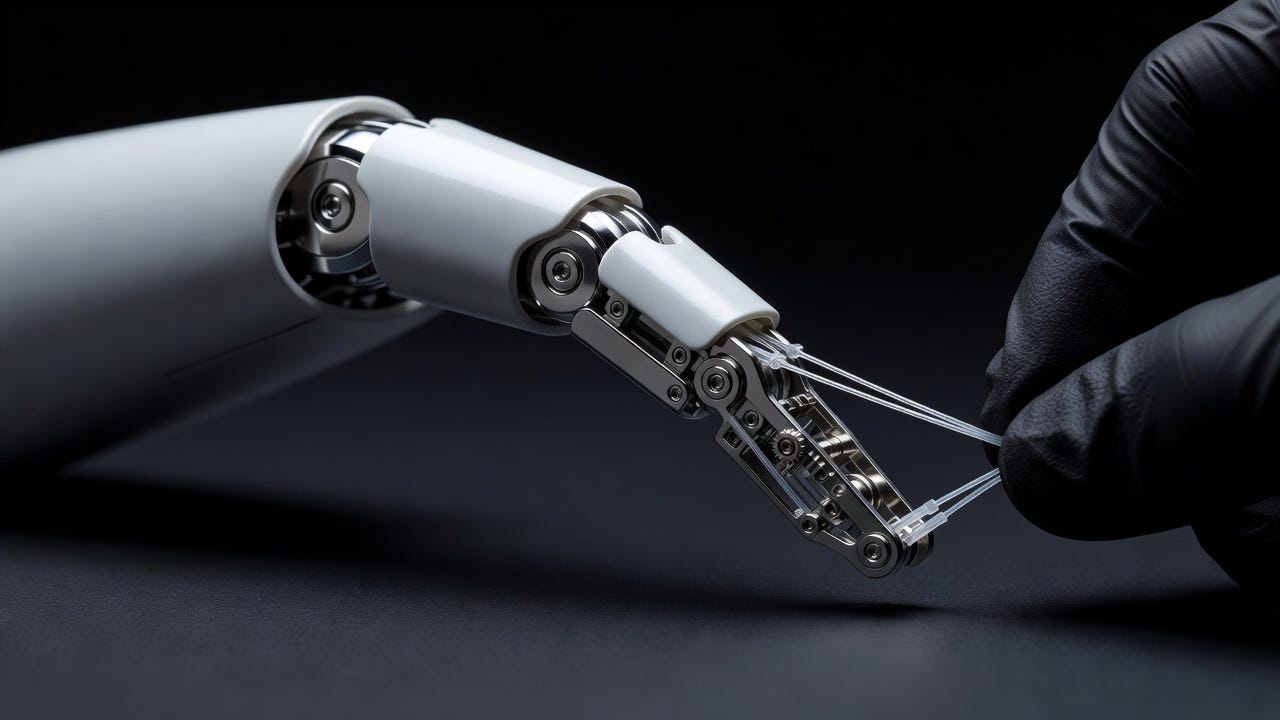
1X’s NEO hand has 25 degrees of freedom, ±0.2mm accuracy, 45N fingertip force, and is IP68 waterproof. It can fold laundry, crack eggs, and assemble furniture. On paper and in the videos, it’s the most advanced tendon-driven hand we’ve seen publicly demonstrated.
1X describes it as “an API to the physical world.” The metaphor is neat, but it misses the point.
APIs are only as good as the infrastructure behind them. And the infrastructure to manufacture this level of dexterity at scale doesn’t exist yet, not at the volumes 1X (and the rest of the industry) will eventually need.
The real question is no longer whether someone can build a highly dexterous hand. It’s whether anyone can build thousands of them at a cost that supports a viable robot business. That’s a supply chain and manufacturing problem, not an engineering one. And 1X’s own teardown quietly reveals how far the industry still is from solving it.
Read the full 1X announcement, then come back, because we’re about to unpack what they didn’t say.
THE CORE TENSION
25 DOF: the most complex dexterous hand ever designed. 10,000 units: target by December 2026. $0: the existing supply chain capacity to support it. UHMWPE tendon material market: $113M today. Hand-tendon rope sub-market: $0.6M. Every component layer depends on suppliers who don’t yet have capacity at this volume.
New here? Start with the full supply chain research map
What 1X Actually Built
Let’s be clear: the engineering is real. Force-controlled quasi-direct-drive The engineering is real. Force-controlled quasi-direct-drive tendons mean losing mechanical advantage and gaining compliance. That trade-off only works with a fast control loop, strong tendons, and precise sensors. 1X appears to have solved all three.
The standout is shear-capable tactile sensing. Most hands detect normal force. Detecting shear force (sliding across a surface) requires denser sensor arrays and more complex signal processing. 1X integrated this into a hand that also hits IP68 waterproofing and food-safe compliance. That’s packaging problems solved that most labs haven’t attempted.
The demonstrations speak for themselves: LEGO assembly, individual screws, spinning light bulbs. 1X built something that works.
If this breakdown is useful, subscribe for free to follow the full humanoid supply chain series.
If this engineering breakdown is useful, you can subscribe for free to follow the full humanoid supply chain series.
The Supply Chain Reality
1X TECHNOLOGIES’ CLAIM
“Every unit is built end-to-end in-house, from tendon materials and 1X Motors to the final soft polymers, skin, and tactile sensing stack.”
Source: 1X Technologies, NEO’s Hands
“End-to-end in-house” means assembly, not vertical integration. The raw materials, motor subcomponents, and sensor fabrication all come from external suppliers.
Three critical component layers stand between 1X and 10,000 hands. Each one has its own supply chain bottleneck. None of them are ready to scale.
Tendons: The Market That Doesn’t Exist Yet
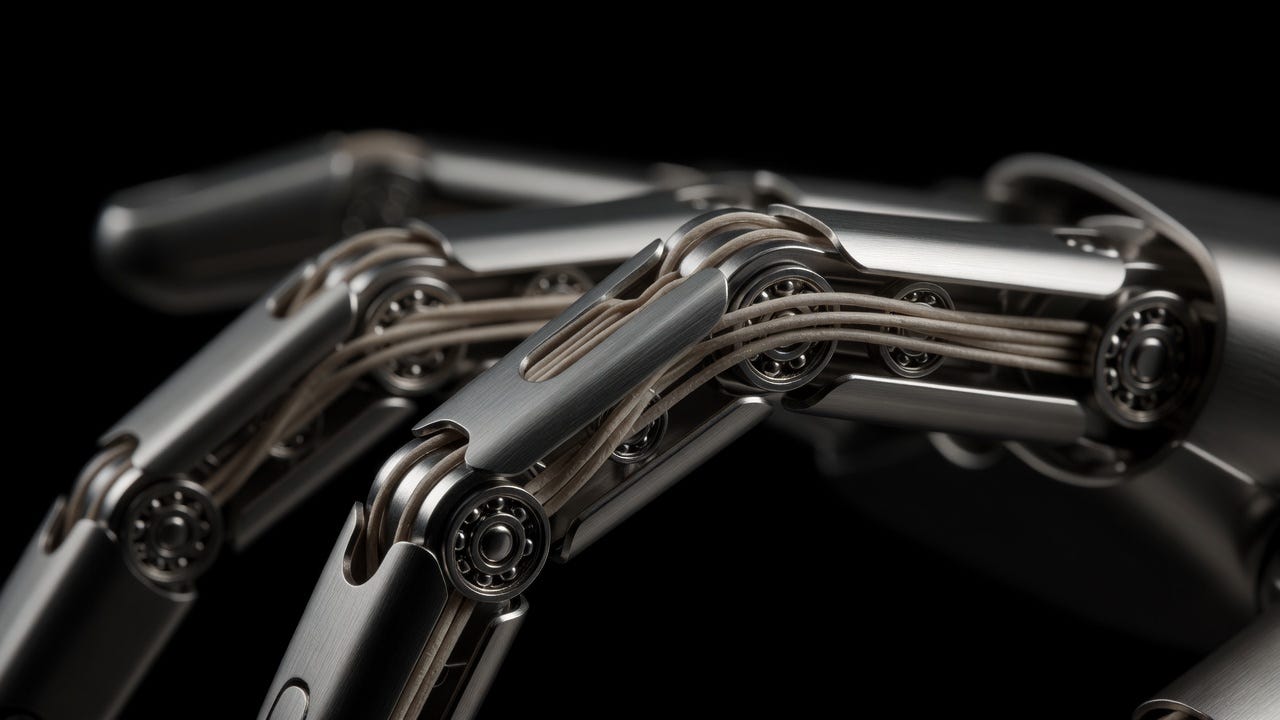
25 DOF = 25-40 tendons per hand.
At 10,000 hands: 250,000+ tendons.
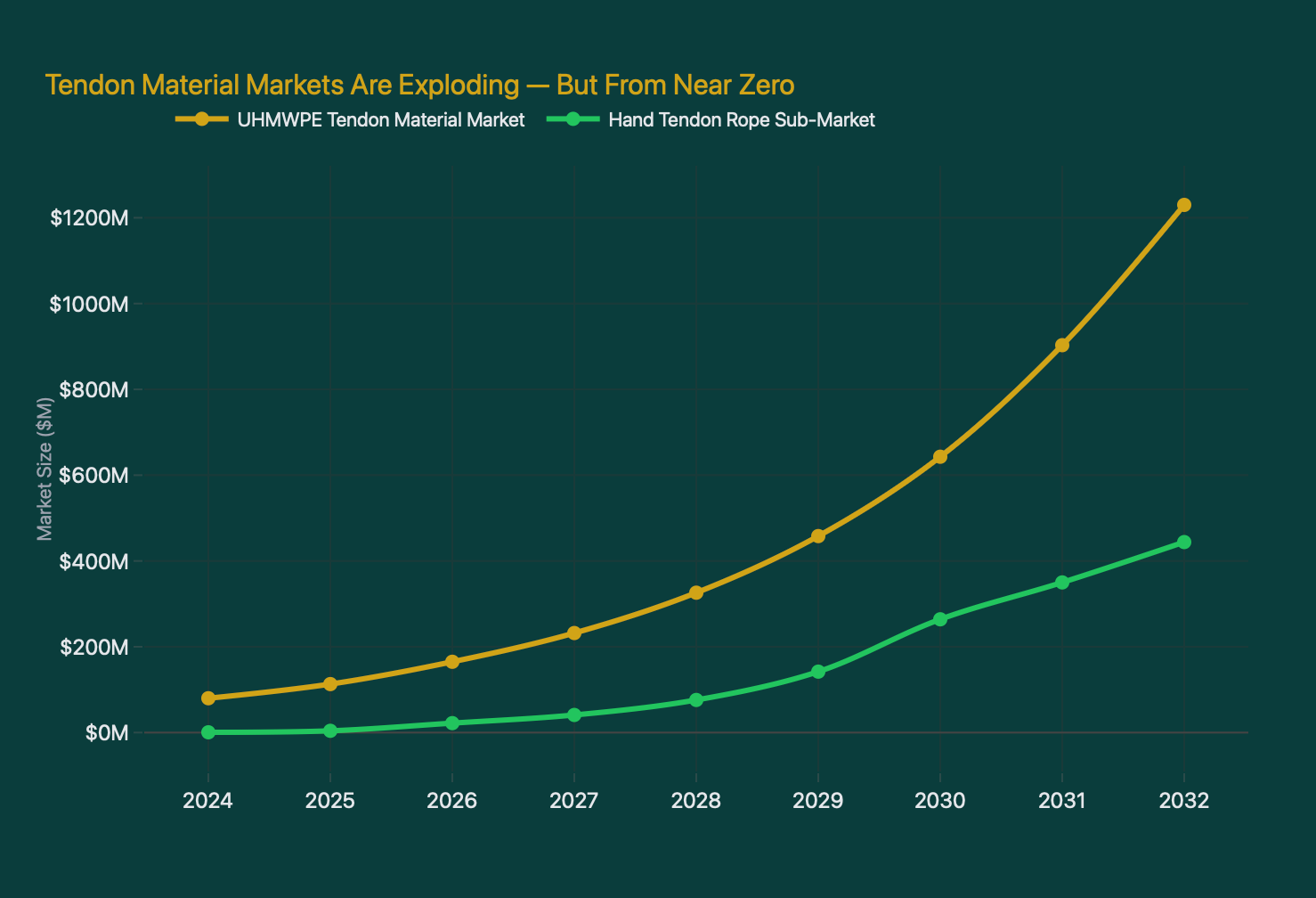
UHMWPE tendon material market: $113M (2025) → $1.23B (2032) at 40.6% CAGR (QY Research).
Dexterous hand tendon rope sub-market: $0.6M (2024) → $444M (2032) at 86.1% CAGR (IntelMarketResearch). Growing from essentially zero.
Carl Stahl Group leads the micro wire rope niche. Tesla Optimus Gen3, Shadow DEX-EE, and LinkerBot L30 all depend on the same supply chain.
Motors: Designed In-House, Built by Someone Else
Hollow-cup motors depend on precision magnets, micro windings, and encoders from a concentrated supplier base. The motor isn't the bottleneck. The motor components are. NdFeB magnets for micro-actuators come from a handful of suppliers. Precision wire winding has limited global capacity.
Sensors: Millions of Components, No Supply Chain
SENSOR SUPPLY CHAIN
Kunwei Technology (Beijing) raised ¥100M Series B+ (March 2026) to scale humanoid F/T sensor production. Each humanoid needs 2-6 wrist/ankle F/T sensors plus 28+ torque/pressure elements, requiring 10-30 signal chain ICs per unit. The signal chain is where cost and complexity live.
1X's quasi-direct-drive architecture reduces discrete joint torque sensors. Tendon tension can be inferred from motor current, eliminating the need for expensive per-joint torque sensing. But wrist-level F/T sensing and tactile skin are non-negotiable. Shear-capable tactile sensing requires dense arrays of micro-force sensors with their own signal processing. At 10,000 units, you need millions of sensor elements. That supply chain doesn't exist yet.
BOM Reality Check: $20K Robot, $5K Hands
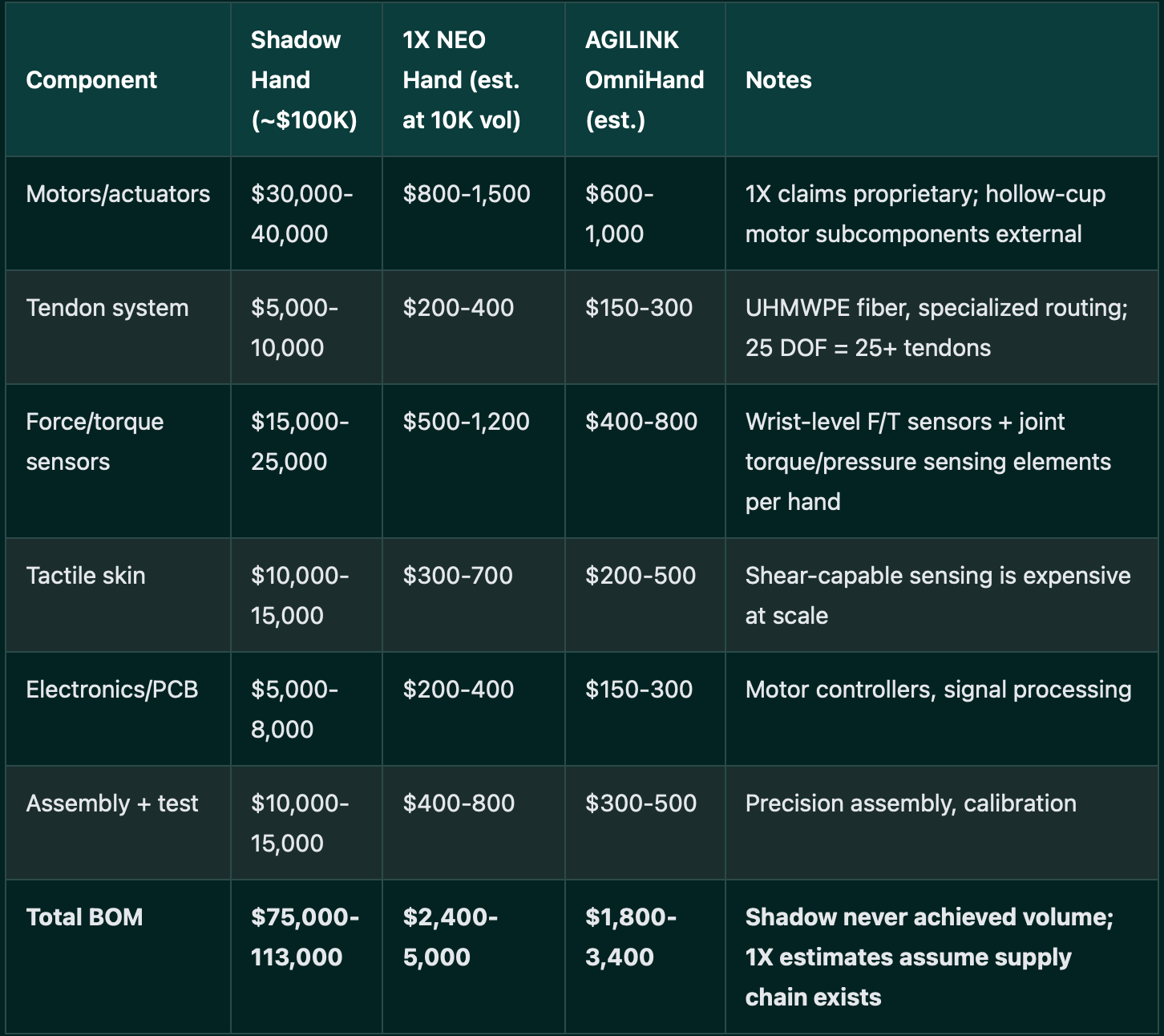
To understand what 1X’s hand costs at volume, you need a baseline. Shadow Robotics (London) has spent 20 years building the gold-standard dexterous hand — the Shadow DEX-EE. 24 DOF, tendon-driven, used in research labs worldwide. It costs $100,000+ per unit and has never shipped at volume. It is the engineering benchmark.
On the other end, AGILINK (AGIBOT’s hand subsidiary) has shipped 8,000+ OmniHand units. 20 DOF, simpler design, no shear-capable tactile skin. But they are the manufacturing benchmark — the only dexterous hand company actually at volume.
1X sits between them: more complex than AGILINK, cheaper than Shadow, targeting 10,000 units by December. The BOM comparison shows why that’s hard.
THE COST REALITY
1X’s hand BOM: $2,400-5,000 at 10K volume. That’s 12-25% of a $20,000 robot’s total BOM in the hands alone. AGILINK comes in lower ($1,800-3,400). 20 DOF needs fewer tendons and simpler sensors. The 5-DOF gap compounds: each DOF adds a tendon, motor, sensor channel, and control loop.
1X’s $499/month subscription model (Forbes) makes more sense than the $20,000 purchase price. At $3-5K per hand BOM, the margin on a one-time purchase is razor-thin. The subscription front-loads hardware cost into recurring revenue: the Tesla FSD playbook.
What This Means
MANUFACTURING REALITY CHECK
1X: 10,000 target by Dec 2026. Most complex hand ever. Supply chain doesn’t exist at this scale.
AGILINK: 8,000+ shipped (per AGIBOT’s 2026 unicorn announcement). Simpler hand (20 DOF). Already at volume.
Shadow: 20 years of R&D. Zero volume. $100K+ per unit.Three players. Three very different manufacturing realities.
The hand race is now a manufacturing competition. The winners won’t have the best demo video. They’ll control the tendon supply chain, the F/T sensor manufacturing base, and the hollow-cup motor component ecosystem.
The next 12 months will tell us whether 1X can turn an engineering breakthrough into a manufacturing reality. Watch the component suppliers: Carl Stahl Group leads the micro wire rope niche. Kunwei Technology’s ¥100M Series B+ signals smart money flowing into F/T sensor capacity. The NdFeB magnet market for micro-actuators is another constraint nobody’s pricing into humanoid valuations.
Key Takeaways
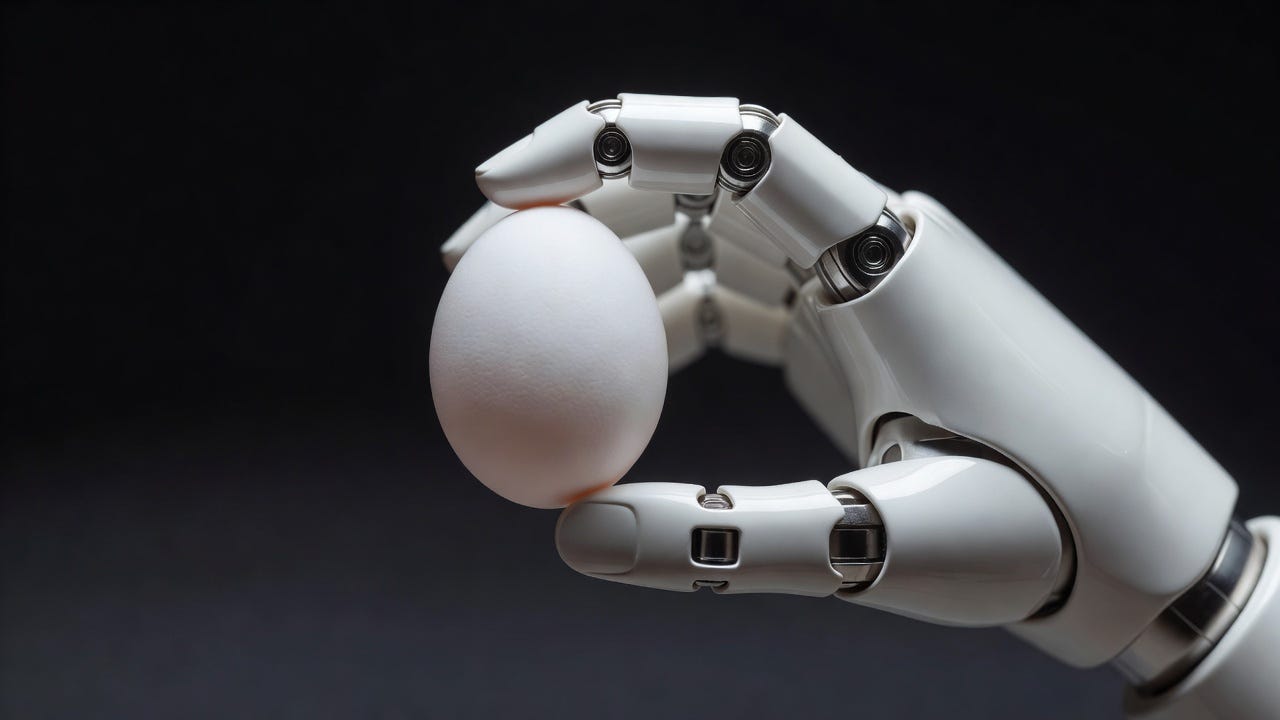
1X built the most dexterous tendon-driven hand ever demonstrated. 25 DOF, shear-capable tactile sensing, IP68 waterproof. The engineering is genuine.
“End-to-end in-house” means assembly, not vertical integration. 1X doesn’t mine UHMWPE, manufacture hollow-cup motor subcomponents, or fabricate tactile sensor arrays. The distinction matters when the supply chain is the constraint.
Hand BOM: $2,400-5,000 at 10K volume. 12-25% of a $20,000 robot in the hands alone. The $499/month subscription is the rational path.
AGILINK has shipped 8,000+ hands (per AGIBOT’s 2026 unicorn announcement). Simpler design, fewer DOF, but manufacturing volume is manufacturing volume.
Component suppliers capture margin regardless of which OEM wins. Carl Stahl, Kunwei Technology, NdFeB magnet manufacturers are picks-and-shovels plays on humanoid scaling.
Manufacturing races are won by whoever owns the supply chain, not whoever owns the best design. The tendon material, motor components, and sensor ICs are where the real leverage lives.
Related Reading
The Actuator Cartel — Who actually controls the motors, reducers, and drive systems every humanoid depends on
The Magnet Nobody Talks About — Why NdFeB supply is the hidden bottleneck behind every robot motor
Tesla, Figure, and Unitree’s Supplier Wars — The supplier-level competition for the same components 1X needs
The Sensor Nobody Covers Series — The tactile sensor supply chain behind the BOM table in this article
Frequently Asked Questions
If 1X’s hand BOM is $3-5K at volume, can they hit a $20K robot price?
The hand alone consumes 12-25% of the $20K target. Add legs, torso, battery, compute, and software, and the total BOM likely exceeds $15K at 10,000-unit volume. That leaves thin margin for a consumer product. 1X’s $499/month subscription model (confirmed by Forbes) makes more sense than the $20,000 purchase price. It front-loads the hardware cost into recurring revenue.
Is AGILINK a serious competitor to 1X in dexterous hands?
AGILINK has shipped more dexterous hands than anyone. Their OmniHand is simpler (20 DOF vs 25 DOF), lower force, no shear-capable tactile skin. But manufacturing volume is manufacturing volume. In a market where supply chain control determines winners, the company that’s already shipping 8,000+ units has a structural advantage over the company targeting 10,000 by December.
Why does the tendon supply chain matter so much?
UHMWPE tendon material market is $113M today. It needs to hit $1.23B by 2032 to meet projected humanoid demand. That 10x growth in seven years requires massive capacity expansion. If capacity lags demand, tendon prices spike, margins compress, and production targets slip. Every humanoid maker depends on the same material. The tendon market is the bottleneck nobody’s pricing into humanoid stocks.
Should investors focus on humanoid OEMs or component suppliers?
Component suppliers. The tendon material, F/T sensor, and micro-motor subcomponent companies capture margin regardless of which humanoid OEM wins. Carl Stahl Group, Kunwei Technology, and NdFeB magnet manufacturers are picks-and-shovels plays on humanoid scaling. Hand assemblers compete on price. Component suppliers compete on capacity. And capacity is scarce.
What’s the most overhyped claim in 1X’s NEO hands announcement?
“End-to-end in-house.” 1X designs the hand. They don’t mine the UHMWPE, manufacture the hollow-cup motor subcomponents, or fabricate the tactile sensor arrays. “End-to-end” means they assemble the hand in-house using components from external suppliers. That’s integration, not vertical integration. The distinction matters when the supply chain is the constraint.
Where does Tesla Optimus fit into the hand race?
Tesla’s Gen 3 hand promises 22 degrees of freedom with a tendon-driven architecture — three thin tendons per finger, all 50 actuators relocated to the forearm. On paper, it’s the most direct competitor to 1X’s approach. In practice, Tesla has delayed the Gen 3 unveiling repeatedly and has not demonstrated the hand publicly. The patent filings are detailed. The working hardware is not. Tesla’s vertical integration gives them a structural advantage if they can execute — they design their own actuators, control systems, and manufacturing processes. But until we see a Gen 3 hand picking up screws on video, Tesla remains the elephant in the room: the competitor everyone assumes will arrive, but nobody can point to.