

The Materials Stack — A 4-Part Series
1. The Magnet Nobody Talks About
2. The Engineering Case for NdFeB
3. The China Chokepoint
4. Who Profits When Robots Need Magnets
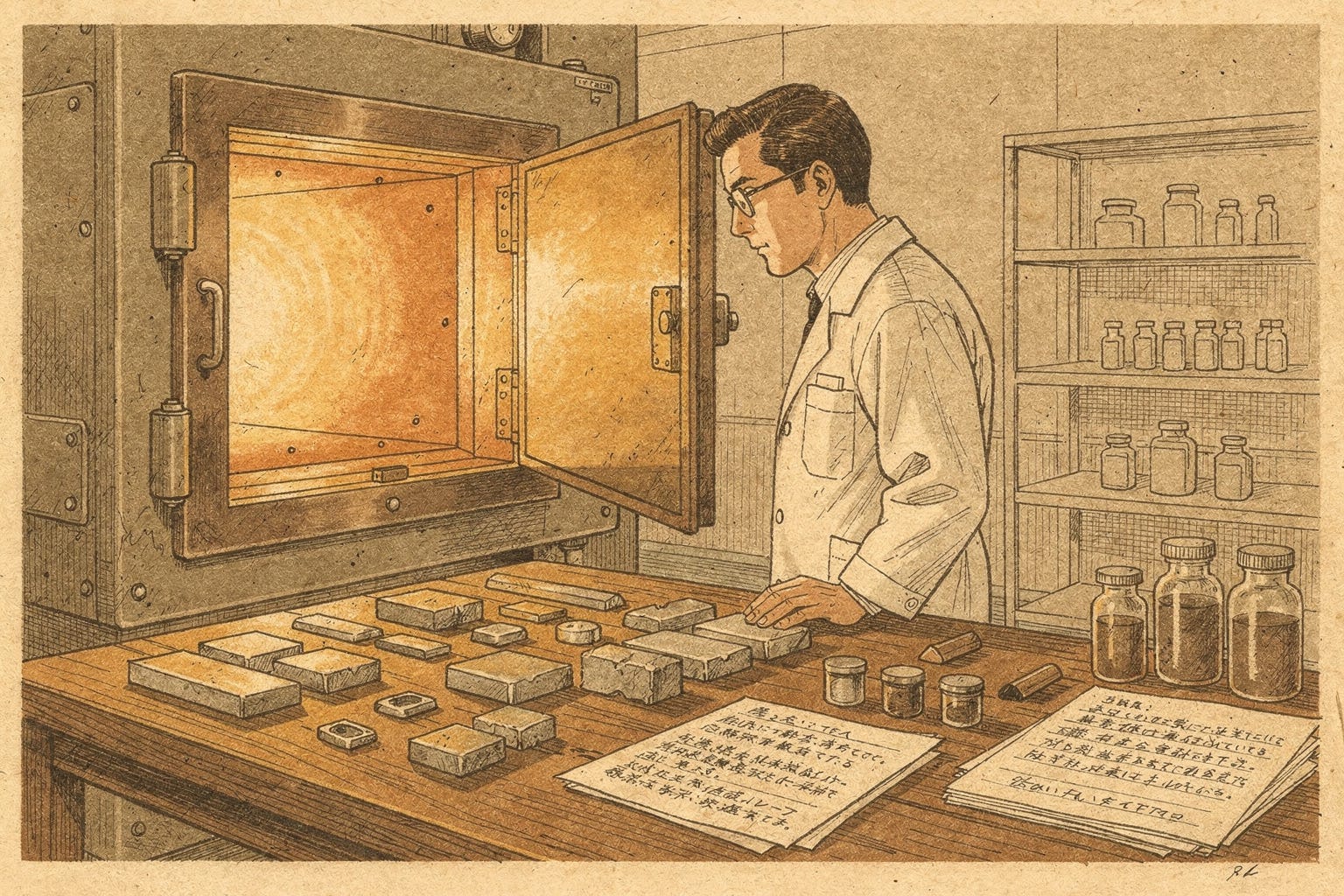
In 1982, a 38-year-old researcher named Masato Sagawa was told by his employer, Sumitomo Special Metals in Japan, to develop “a magnet that doesn’t break.”
Sagawa was, by most accounts, a failed academic. He had washed out of university research. He had lost confidence. He joined a corporate lab, the kind of place where ambition goes to file patents and retire. Everyone in the field knew that iron-based permanent magnets were impossible. The physics didn’t work. The crystal structures were wrong. The smart people had moved on.
Sagawa tried anyway. He spent years tinkering with different compositions, different ratios of rare earth elements and iron, different sintering temperatures. Most of his experiments failed. The magnets were brittle. The crystal structures wouldn’t hold. His colleagues at Sumitomo must have wondered what this quiet, stubborn man was doing with all that furnace time.
What followed was one of those quiet moments in history that nobody notices at the time but that reshapes everything downstream. In 1984, two teams on opposite sides of the world, Sagawa’s group at Sumitomo in Japan and a team at General Motors in the United States, independently discovered the same alloy: Nd₂Fe₁₄B. Neodymium, iron, and boron. A crystalline structure that, against all expectations, produced the strongest permanent magnet ever made.
Sagawa was awarded the Japan Prize in 2012. He has been nominated for the Nobel Prize repeatedly. He has never won it.
The material he discovered, neodymium-iron-boron, or NdFeB in the shorthand that engineers use, is the strongest commercially available permanent magnet in the world. Its energy product, the measure of how much magnetic energy a material can store, is over ten times that of the humble ferrite magnets you might find stuck to a refrigerator. In its highest grade, N52, NdFeB can produce a remanence of 1.44 Tesla, a magnetic field strong enough to snap your fingers together if you got them between two blocks of the stuff.
A material that didn’t exist 42 years ago is now the invisible foundation of every humanoid robot you’ve seen walk across a stage.
And this is not some niche curiosity. This is a material at the center of what might be the most consequential technology race of the next two decades. The humanoid robot industry, led by Tesla, Figure, Boston Dynamics, and a growing list of Chinese competitors, is projected to be worth $38 billion by 2035, and possibly ten times that by 2040. Every single one of those robots will need NdFeB. Every joint. Every finger. Every actuator.
What makes this story worth telling is not the technology itself. It is the supply chain behind it. Because the supply chain for NdFeB is one of the most geopolitically concentrated in the world, more concentrated than semiconductors, more concentrated than lithium, more concentrated than almost any critical material you can name.
The Secret in the Machine
Let me show you something that nobody talks about at robot launch events.
Every humanoid robot, every Atlas, every Optimus, every Figure, every Unitree, needs between 28 and 76 electric motors to move. Motors in the legs to walk. Motors in the arms to lift. Motors in the hands to grip. Motors in the neck to turn the head. Motors in the torso to balance. Tesla’s Optimus, the robot you’ve probably seen the most of, needs approximately 40 motors and roughly 4 kilograms of NdFeB magnets per unit. Over 95 percent of the motors used in humanoid robots contain rare earth permanent magnets.
picture that for a moment. About four kilograms. That is roughly the weight of a bag of sugar. Except this bag of sugar is distributed across 40 tiny, precision-engineered cylinders, each one containing a chunk of NdFeB magnet that makes the difference between a motor that works and a motor that doesn’t.
And here is the part that should make you sit up. You’ve watched these robots walk across stages. You’ve seen them wave, pick up objects, navigate rooms, fold laundry. Impressive, right? But nobody at those launch events told you that each robot is wearing several kilograms of a material that 94 percent of the world’s supply comes from one country.
Ninety-four percent.
China controls 94 percent of global sintered NdFeB magnet manufacturing. It controls 91 percent of rare earth processing and refining. And when it comes to the heavy rare earths, dysprosium and terbium, the elements that keep these magnets working at high temperatures, China controls roughly 99 percent of refining capacity.
One country. One supply chain. And every humanoid robot on Earth depends on it.
This is the story of the magnet nobody talks about.
The Material That Changed Everything
We should begin with what NdFeB actually does, because the physical intuition matters more than the chemistry.
Imagine you want to build a motor the size of a sugar cube, a motor powerful enough to curl a robot’s finger around an eggshell without cracking it. That motor needs a permanent magnet inside it. The magnet provides the static magnetic field that interacts with the electric current in the motor’s windings, creating the force that spins the rotor.
The stronger the magnet, the more force you get from a smaller motor. And NdFeB is, by a wide margin, the strongest permanent magnet material available. Its energy product, the number that engineers use to compare magnets, measured in mega-gauss-oersteds, or MGOe, reaches 52 in its best grades. Ferrite magnets, the cheap ceramic kind used in everything from speakers to refrigerator decorations, top out around 4.5. That is not a small difference. That is a tenfold advantage.
This matters enormously for humanoid robots, and here is why.
The motors in a robot’s hip and knee joints need to produce 50 to 100 Newton-meters of continuous torque. That is the force required to keep a 60-kilogram robot standing, walking, climbing stairs. Each of those motors requires 30 to 60 grams of sintered NdFeB. There is no way around it, not if you want the motor to fit inside a human-sized leg.
But the real problem is the hands.
Hand motors in humanoid robots are 8 to 15 millimeters in diameter. That is roughly the width of a pencil. Inside that tiny cylinder, you need enough magnetic force to give a robot finger the dexterity to pick up an egg, thread a needle, or turn a doorknob. NdFeB’s energy density advantage is magnified at small scales, the smaller the motor, the more the magnet matters. If you tried to use ferrite magnets instead, the motors would need to be three to five times larger. Try building a robot hand with fingers the size of bratwursts. The fingers won’t close. The hand won’t grip. The robot won’t work.
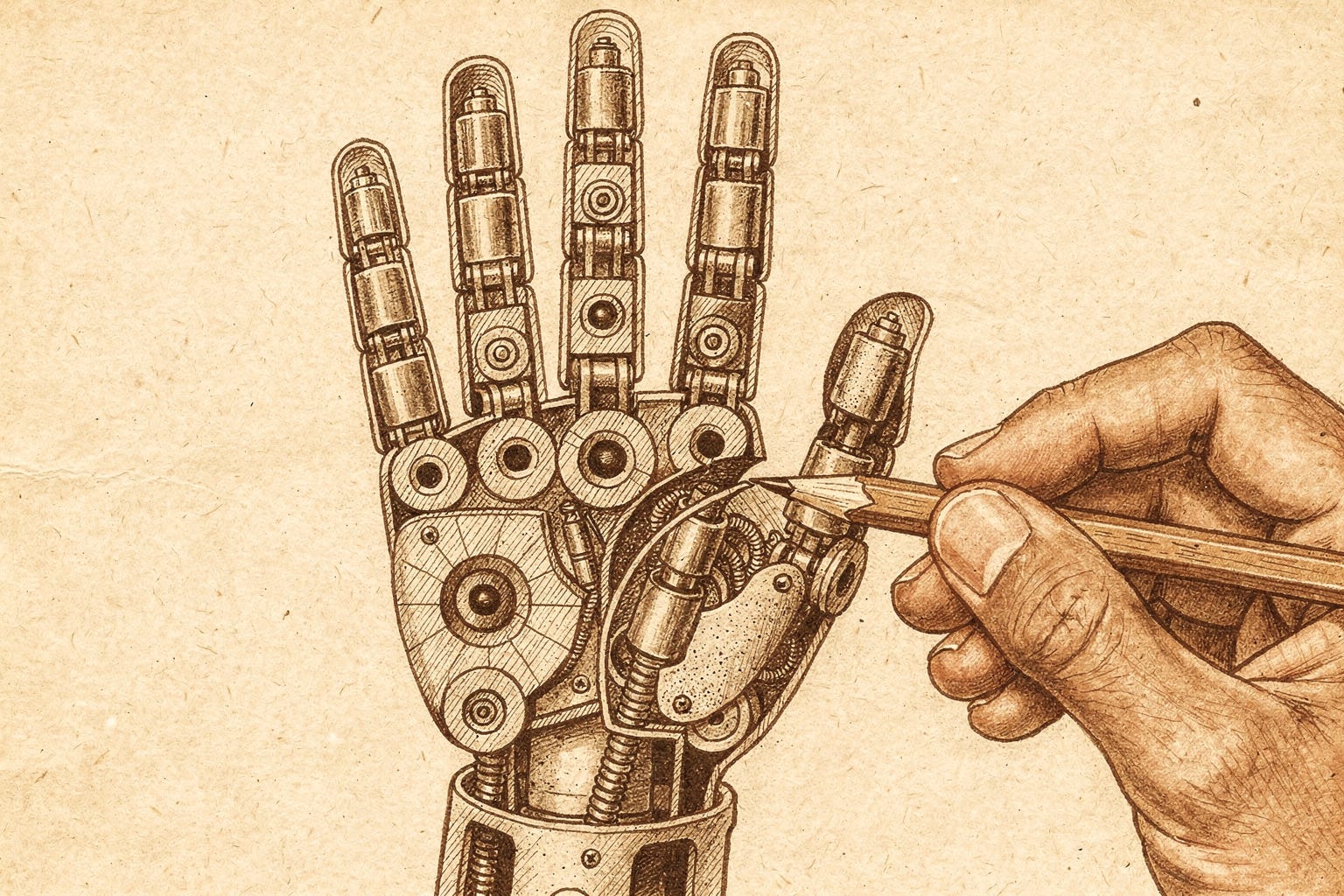
This is the detail that kills the casual objection of “just use a different magnet.” You can, in theory, substitute ferrite or samarium-cobalt into a large industrial motor where you have room to spare. You cannot substitute it into a robot hand. The physics simply will not allow it.
And samarium-cobalt, the other serious rare earth magnet? It is more expensive than NdFeB, less powerful, and its supply chain is, you guessed it, also dominated by China. Iron nitride magnets, which some researchers believe could eventually approach NdFeB performance, are at technology readiness level 2 or 3. That means laboratory demonstrations. Not production. Not for at least ten years, and probably longer.
So here we are. A material invented 42 years ago by a man who thought he was a failed scientist is now the only viable option for the motors that make humanoid robots possible. And there is no substitute on the horizon.
The Demand Wave
To put this in perspective, let us talk about numbers.
The global NdFeB magnet market was worth approximately $30.5 to $31.7 billion in 2025. Industry projections put it at $59.7 to $65.3 billion by 2034, a compound annual growth rate of roughly 7 percent. That sounds manageable. A market doubling over a decade. Supply chains have handled worse.
But those projections were made before the robots.
Goldman Sachs projects the humanoid robot market at $38 billion by 2035. Morgan Stanley is more aggressive, estimating $357 billion by 2040. And then there is Elon Musk, who has projected that Tesla could eventually produce 10 billion Optimus units, a number so large it almost doesn’t mean anything, except as a statement of intent.
Here is what that intent looks like in magnet terms. If the world were to produce 10 billion humanoid robots, Musk’s projection, not mine, it would require 186 times the current annual global NdFeB production. Not 186 percent. One hundred and eighty-six times.
Now, 10 billion robots is a fantasy number. Even 1 percent of it, 100 million robots, would require nearly double the world’s current NdFeB output. And that is just the robots.
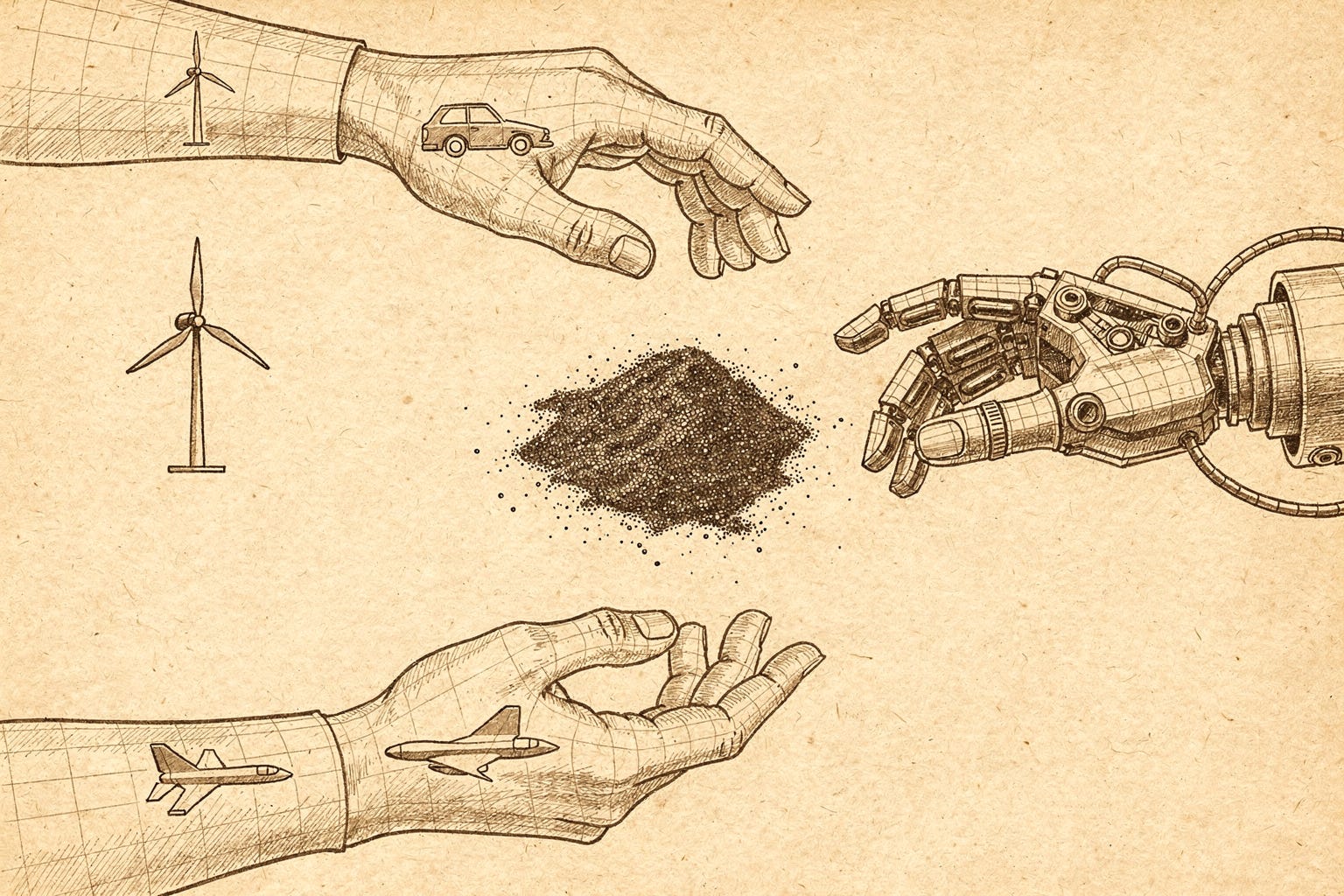
Robots are not the only hungry mouth at the table. Every electric vehicle traction motor requires one to three kilograms of NdFeB. Global EV sales exceeded 17 million units in 2024, and that number is climbing fast. Direct-drive offshore wind turbines, the big ones, the ones that matter for the energy transition, use 500 to 700 kilograms of NdFeB per megawatt of capacity. A single large offshore installation can consume tonnes of the stuff. And defense applications, the F-35 fighter jet, submarine motors, missile guidance systems, have inelastic demand with absolutely no substitution path. A military planner does not have the option of saying “let’s use a weaker magnet.”
this like a dinner table. There are already three very large, very hungry guests sitting down, the EV industry, the wind industry, and the defense establishment, and now a fourth guest is walking through the door. A guest who, if the projections are even half right, will eventually eat more than the other three combined.
The humanoid robot industry wants to enter a market that is already stretched thin. The supply chain was not built for this. It was barely keeping up as it was.
The Chokepoint
I want to tell this part of the story carefully, because I think it reads better as a geopolitical thriller than as a table of statistics.
China's dominance in rare earth magnets did not happen by accident. It happened over three decades of deliberate industrial policy, subsidized mining, integrated supply chains, and a willingness to accept environmental costs that Western nations would not. The Bayan Obo mine in Inner Mongolia, the world's largest rare earth deposit, accounts for the majority of China's rare earth reserves. One mine. One province. One country.
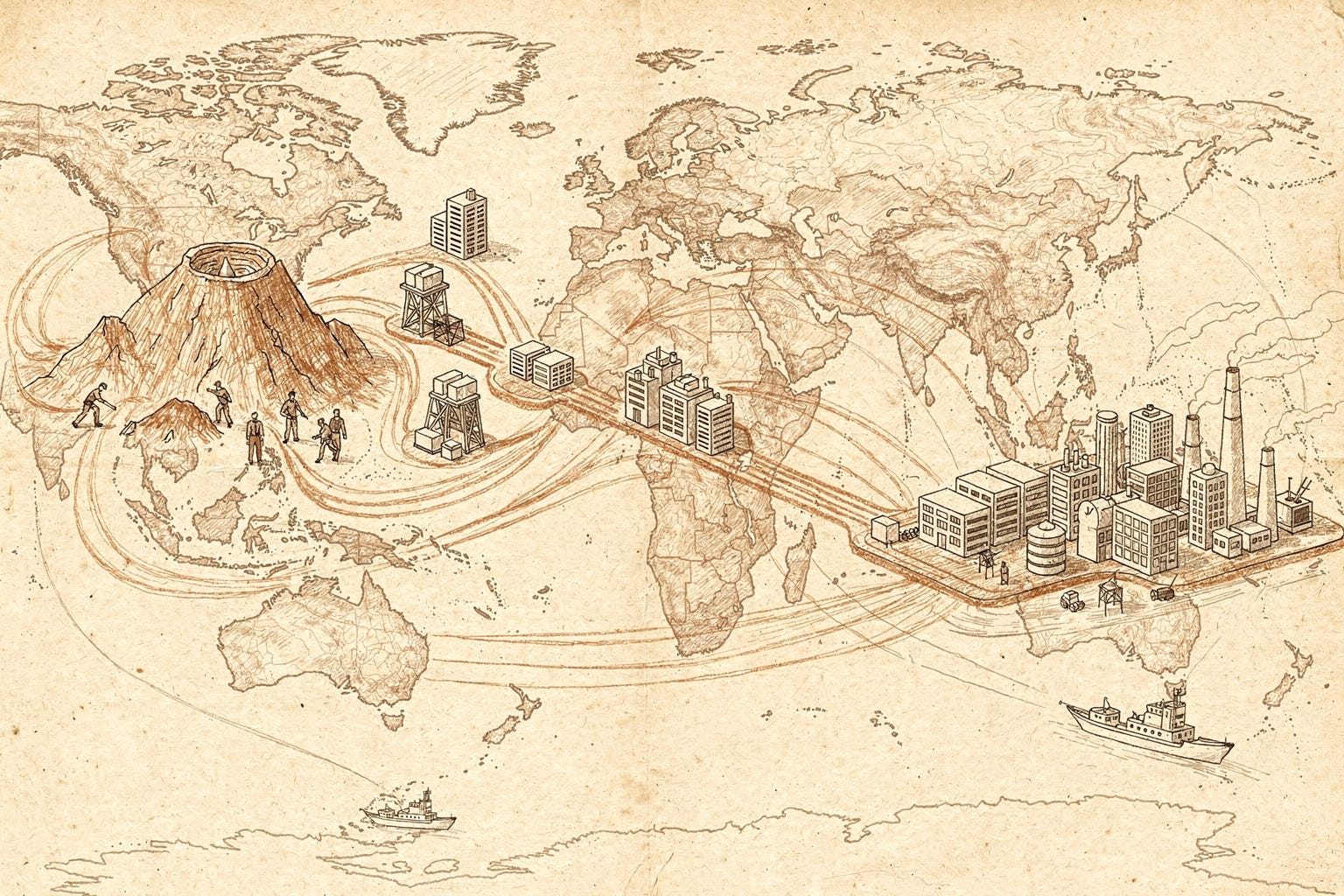
The result is a supply chain so concentrated that it makes the semiconductor industry’s dependence on TSMC look diversified by comparison.
Between 2014 and 2024, China’s NdFeB production capacity grew from 30,000 tonnes per year to approximately 260,000 tonnes. That is an almost ninefold increase in a decade. During the same period, non-China capacity, everything built by the United States, Europe, Japan, and Australia combined, grew to roughly 8,000 to 15,000 tonnes. That is 3 to 6 percent of the global total.
The economics make this gap nearly impossible to close quickly. Chinese producers access neodymium-praseodymium, the key raw material, at around $110 per kilogram domestically. Non-Chinese producers pay $275 to $400 per kilogram. That is a 250 percent premium before you have even turned on the furnace. Before you have paid a single worker. Before you have shipped a single gram. Chinese magnets benefit from 30 to 50 percent lower production costs due to scale, integrated supply chains, lower labor costs, and government subsidies.
If you are a Western company trying to build a robot magnet, you are paying two and a half times what your Chinese competitor pays for the same raw material. That is not a competitive disadvantage. That is a wall.
And then, in April 2025, the wall got higher.
On April 4, 2025, the same week as President Trump’s “Liberation Day” tariffs, China added seven medium and heavy rare earths, along with dysprosium- and terbium-containing NdFeB magnets, to its export restricted list. The announcement, officially known as Announcement No. 18, did not ban exports outright. Beijing did something more elegant: it made you apply for an export license, then took its time processing the applications. License applications take 60 to 120 days, with no guarantee of approval and no clear criteria for decision-making.
The effect was immediate and devastating. China’s rare earth magnet exports plunged 74.3 percent year-over-year at their lowest point. But the restriction was not applied evenly. European imports surged 60 percent while US imports fell 11 percent. Beijing was using supply allocation as a geopolitical tool, rewarding allies, punishing adversaries, all without technically breaking any trade agreement.
The most striking number I found in my research was this: yttrium exports to the United States fell to 17 tons in the eight months following the restriction, compared to 333 tons in the preceding eight months. That is a 95 percent decline. Not a gradual slowdown. A spigot turned off.
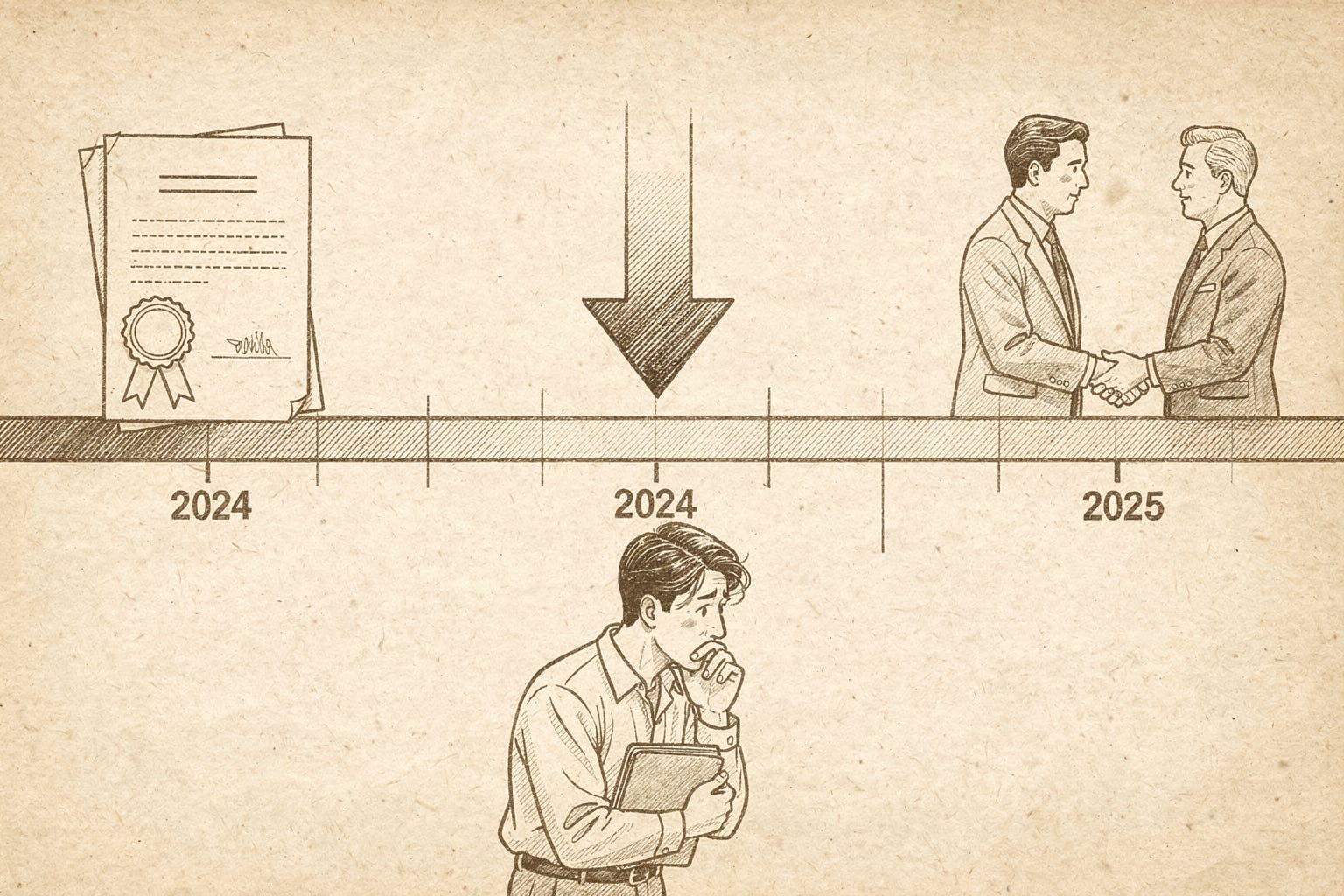
Then there was the moment the abstract became personal.
On Tesla’s Q1 2025 earnings call, a call watched by millions of investors, analysts, and robot enthusiasts, Elon Musk admitted that Optimus production was “impacted” by China’s rare earth magnet export restrictions. His exact words:
“China wants some assurances that these are not used for military purposes, which obviously they’re not. They’re just going into a humanoid robot.”
The richest man in the world, on an earnings call watched by millions, admitted that his robot program was waiting on an export license from Beijing. Not a cutting-edge chip. Not a proprietary software library. Not an AI model. A magnet. A chunk of metal alloy that most people have never heard of, invented by a man most people have never heard of, in a country that has decided it gets to decide who receives them.
What Could Break This
Let us steelman the counter arguments first, because intellectual honesty demands it.
The West is building. MP Materials operates the only integrated US mine-to-magnet production facility. Its 10X manufacturing plant is targeting approximately 10,000 tonnes per year of NdFeB capacity by 2028, backed by a $200 million incentive package and $400 million from the Department of Defense. Announced expansions across the US, Europe, Japan, and Australia could bring non-China NdFeB capacity to 25,000 to 35,000 tonnes per year by 2028 to 2030.
That sounds promising until you remember that China currently produces 260,000 tonnes. Even the most optimistic Western buildout would represent roughly 10 to 13 percent of global capacity. The West is building. But it is building from 3 percent.
Then there is the diplomatic track. In November 2025, Presidents Trump and Xi reached an agreement to suspend export restrictions for approximately one year, until roughly October 2026. The truce has eased some of the immediate pressure. But “eased” is doing a lot of work in that sentence. Even during the truce, US companies report greater disruption than European ones. Export licensing remains slow, opaque, and highly discretionary. Military-affiliated companies are effectively barred from receiving licenses. They shook hands. The pipes are still clogged.
On the technology front, the one that optimists always point to, researchers are working on alternatives. Iron nitride magnets are the most exciting. Theoretical performance near NdFeB levels, made from abundant materials, no rare earths required. But they remain at technology readiness level 2 or 3, which in plain English means “we can make it work in a lab, sometimes, under controlled conditions.” A commercially viable, mass-produced iron nitride magnet is at least ten years away. Probably longer. Motor design innovations, like grain boundary diffusion, can reduce heavy rare earth content by 40 to 60 percent. That helps. It does not eliminate the dependency.
And recycling? The NdFeB recycling industry is growing, using processes like hydrogen decrepitation to recover magnets from old electronics and industrial motors. But the volumes are tiny relative to demand, and the feedstock from humanoid robots will not exist in meaningful quantities until the 2030s at the earliest. You cannot recycle robots that have not been built yet.
The Question That Lingers
So here we are.
A material invented by a failed academic in a Japanese corporate lab in 1984 is now the invisible foundation of the most ambitious technology project of the 21st century. Humanoid robots, the machines that Tesla, Figure, Boston Dynamics, and a dozen other companies are racing to build, cannot move without NdFeB magnets. There is no substitute. There is no workaround. Not today, and not for at least a decade.
Ninety-four percent of those magnets come from one country. That country has already demonstrated, in April 2025, that it is willing to use that leverage. The Trump-Xi truce expires in October 2026.
I keep coming back to something Musk said on that earnings call. “They’re just going into a humanoid robot.” As if that made it simpler. As if a robot is less geopolitically sensitive than a missile. But I wonder if he understands, if anyone in Silicon Valley truly understands, that the supply chain for the material inside every actuator, every joint, every finger of every robot they are building runs through a single mine in Inner Mongolia, a handful of smelters in Baotou, and a licensing office in Beijing that answers to people who have very different priorities than shipping magnets to Fremont.
In Part 2 of this series, we will go deeper into the engineering, why motors need this specific material, how the actuator supply chain actually works, and where the technical bottlenecks are. In Part 3, we will look at the geopolitics, the export controls, the diplomatic chess, and what happens when the truce expires. And in Part 4, we will look at who stands to benefit: the Western companies trying to build alternative supply chains, and whether any of them can actually compete.
But for now, I want to leave you with one image.
The next time you see a humanoid robot walk across a stage, smooth, confident, almost human, imagine roughly four kilograms of neodymium-iron-boron hidden inside its body. A material that didn’t exist 42 years ago. Discovered by a man the world overlooked. Controlled by a country that has already shown it will squeeze the supply.
The robots are coming. The magnets are finite. And nobody at the launch event is talking about it.
Next time, we dig into the engineering, and it is fascinating. Hope everyone has a good week, and I’ll talk to you soon.
Machine Narratives Research provides institutional-grade analysis of the humanoid robotics supply chain. This is Part 1 of a four-part series on NdFeB magnets and the future of robot manufacturing.
Sources: CSIS (Jun 2026); S&P Global (Jan 2026); Global Times / Securities Times (Apr 2025); Arnold Magnetics (2025); EurekAlert / Kobe University (Jan 2025); The Wire China (Jun 2025); IEA (2025); DOE (2024); BMI (H2 2025); Spherical Insights; Precedence Research; Goldman Sachs; Morgan Stanley; Adamas Intelligence (2025); IDTechEx (2026); Machine Narrative Research.