

The Actuator Cartel — A 5-Part Series
1. Who Controls the Robot Muscle Supply Chain
2. From Harmonic Drives to Torque Motors
3. The Chinese Are Coming
4. Tesla, Figure, and Unitree’s Supplier Wars
5. The Actuator Cartel’s Endgame
In 1981, a small Japanese company called Harmonic Drive Systems introduced a gear mechanism that would reshape robotics for the next four decades. The harmonic drive, a strain wave gear that achieved zero-backlash precision in a compact package, became the backbone of industrial robots, surgical arms, and eventually, the humanoid robots that dominate today’s headlines. But what most investors don’t realize is that we’re now witnessing the end of that era. The torque motor, a direct-drive technology that eliminates gears entirely, is eating harmonic drive’s lunch, and the transition says something profound about where robotics is heading.
The forty-year arc of precision motion control, from harmonic drives to torque motors, matters more than most people realize. The story of precision motion is the story of robotics itself, and understanding that lineage is essential to understanding who wins the humanoid race.
First, Let’s Start with the Harmonic Drive
To understand why harmonic drives dominated for so long, you have to understand the problem they solved. Industrial robots need to move precisely: we’re talking about repeatability measured in micrometers. But electric motors spin fast and with relatively low torque. You need some way to translate that high-speed, low-torque rotation into slow, powerful, precise movement.
The traditional solution was planetary gears, essentially a set of gears arranged in a circle around a central sun gear. They worked, but they had backlash. Backlash is the tiny bit of play between gear teeth, and in precision applications, even a few arc-minutes of backlash is unacceptable. Imagine a surgical robot that overshoots its target by a millimeter because of gear slack. Not ideal.
The harmonic drive solved this through a clever bit of mechanical engineering. Instead of rigid gears meshing together, a harmonic drive uses a flexible spline, a thin-walled cup that deforms elliptically as it rotates. This “strain wave” gearing eliminates backlash entirely because the teeth are always in contact. For forty years, it was the gold standard.
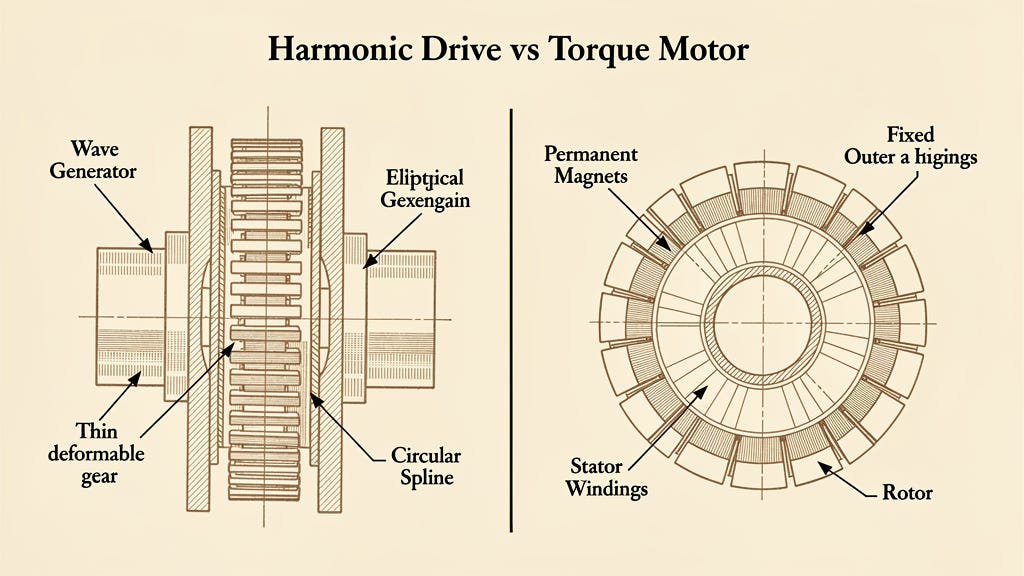
Figure 1: Harmonic drive vs. torque motor: internal structure comparison. The harmonic drive (left) uses a flexible spline and wave generator, while the torque motor (right) eliminates gears entirely with direct magnetic coupling. Source: Machine Narrative Research.
Harmonic Drive Systems, founded in 1970 in Tokyo, built a quiet monopoly on this technology. By the 1990s, their gears were in virtually every industrial robot on the planet: FANUC, KUKA, ABB, Yaskawa. If you wanted zero-backlash precision, you bought harmonic drives. End of story.
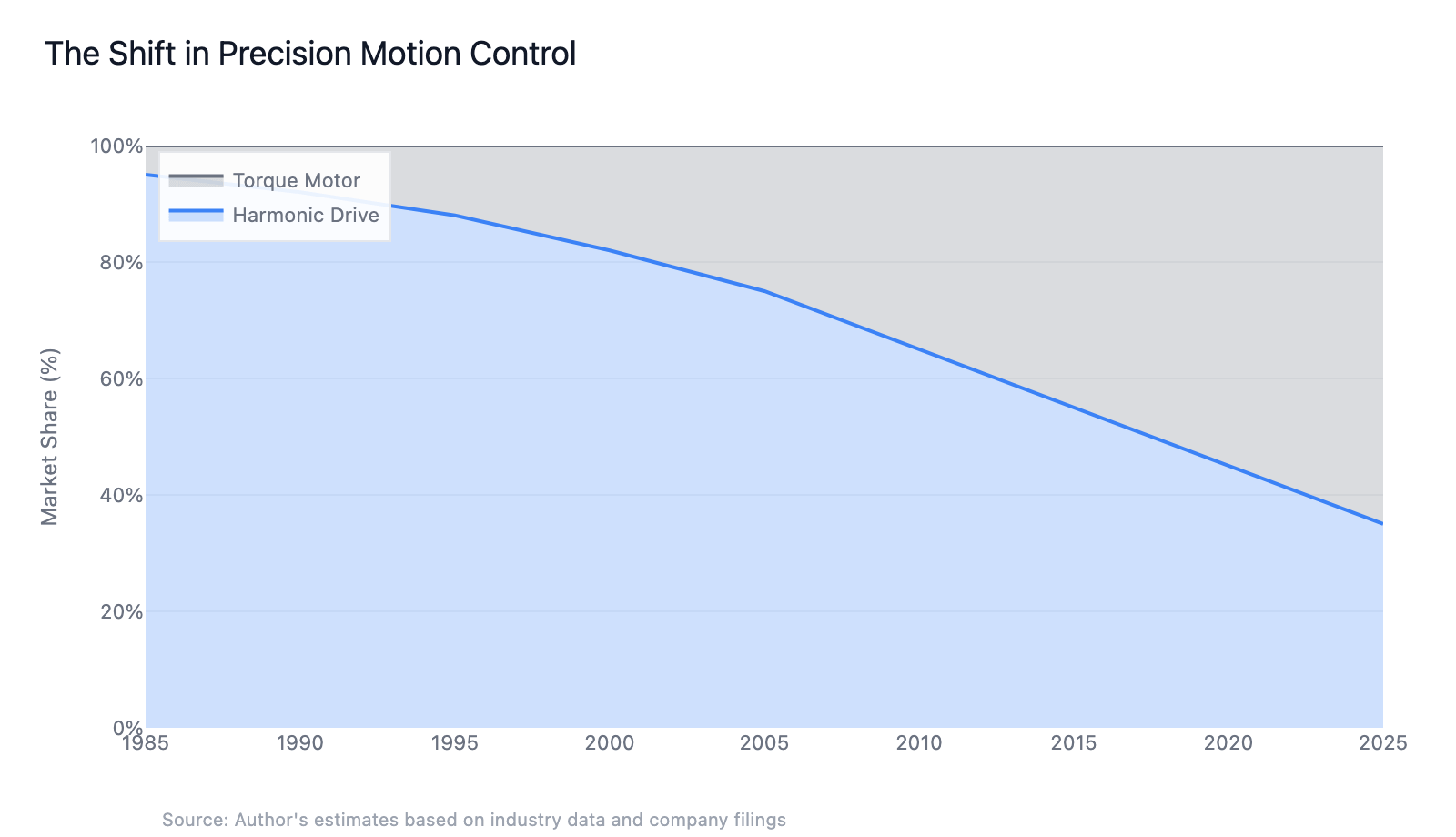
Figure 2: The shift in precision motion control technology market share over four decades. Source: Author’s estimates based on industry data and company filings.
The chart above tells the story visually. In 1985, harmonic drives held roughly 95% of the precision motion market for robotics (author's estimate based on industry structure and available documentation). They were the only game in town for high-precision, zero-backlash applications. But look at what happens after 2010. The blue line, harmonic drive share, starts a steady decline. The gray line, torque motors, begins its ascent. By 2025, I estimate torque motors have captured roughly 65% of new robotic actuator deployments, while harmonic drives have fallen to about 35%.
